
African boxthorn
Lycium ferocissimum Miers
Description
Growing requirements
African boxthorn (Lycium ferocissimum) belongs to the Solanaceae family. It is a robust, thorny shrub that has gained notoriety for its invasive nature in many parts of the world.
Native to Southern Africa, this species has become a significant ecological concern in regions like Australia and New Zealand, where it thrives in diverse climates.
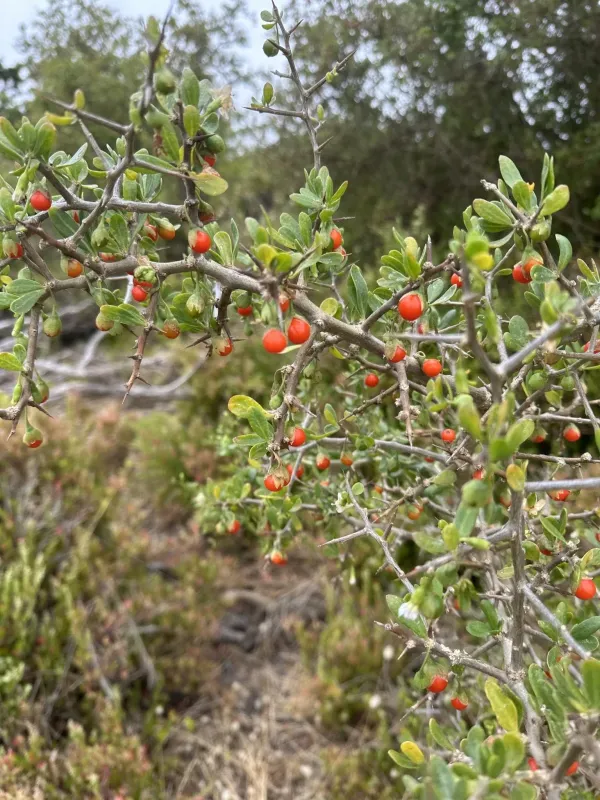
The plant features woody, spreading branches covered in sharp spines, with small, fleshy leaves and bright red berries that are highly attractive to local bird species.
It is remarkably tolerant of poor soil conditions, including saline and sandy environments, making it an incredibly resilient pioneer plant in disturbed areas.
Requirements for growth are minimal: the plant exhibits high drought tolerance and can withstand strong coastal winds, allowing it to dominate marginal lands and rangelands.
Main diseases and pests
The primary threat posed by African boxthorn is its ability to spread rapidly via seeds, which are dispersed over long distances by birds feeding on the fruit.
It lacks significant natural pests or pathogens that could keep its population in check, allowing it to form dense, impenetrable thickets that exclude all other vegetation.
Agricultural productivity is hampered by the plant, as the massive thorns discourage livestock from grazing and damage the hides and eyes of farm animals.
Mechanical removal is rarely effective as the plant possesses a deep, persistent taproot system that allows for vigorous regrowth after cutting.
Furthermore, it serves as an alternative host for various agricultural pests and viral diseases that can easily transmit to neighboring commercial crops like tomatoes.