

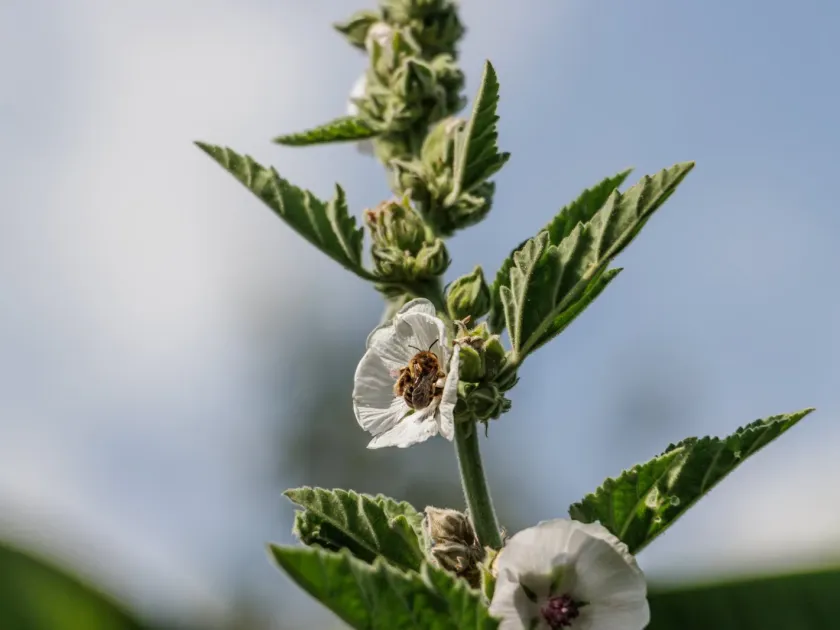
Description
Sowing dates
Marsh mallow is typically sown in late autumn, around October, or early spring as soon as field conditions allow. Autumn sowing allows the seeds to undergo natural stratification, which leads to more uniform and vigorous germination in the following season.
Farmers use precision seed drills with row spacing between 45 and 60 centimeters, which is optimal for subsequent mechanical inter-row cultivation. Seeds should be planted at a depth of 2–3 centimeters in light soils, or shallower in heavier soil types, to ensure proper emergence.
The seeding rate ranges from 8 to 12 kilograms per hectare, depending on seed quality and the chosen cultivation method. It is crucial to roll the field after sowing to ensure good seed-to-soil contact, which significantly improves the germination rate in drier conditions.
Since seedlings develop slowly, weed control during the early stages of growth is essential for crop success. During the first year, the plant focuses on establishing a strong root system and a rosette of leaves rather than producing biomass for commercial harvest.
While direct seeding is the standard commercial practice, the transplanting method from greenhouses can be used for smaller plots to ensure a more consistent crop stand. However, this increases labor costs significantly compared to traditional field sowing.
Growing requirements
Althaea officinalis is a perennial herb of the Malvaceae family, native to temperate and subtropical regions of Eurasia. It thrives in sunny, open locations, though it benefits from shelter against strong, drying winds that can affect leaf quality.
The plant is moisture-loving, particularly during the germination phase and periods of rapid vegetative growth. However, it is highly sensitive to waterlogging; therefore, well-drained, fertile soil is vital for preventing root rot and ensuring plant health.
Rich loamy soils or well-drained black earths (chernozems) with a neutral or slightly alkaline pH are ideal. Heavy clay soils should be avoided as they often result in distorted, branched root systems that are difficult to clean and process after harvest.
Effective fertilization is necessary for optimal yields. Nitrogen-rich fertilizers are recommended in the early spring to promote leaf growth, while phosphorus and potassium applications are essential during the second half of the season to support robust root development.
Marsh mallow is generally hardy, but in colder climates, it may require protection during exceptionally harsh winters to prevent damage to the crown. Optimal growth temperatures range between 20 and 25 degrees Celsius, allowing for steady biomass accumulation.
Yield
Industrial yields of Marsh mallow roots at the end of the second year usually range from 1,500 to 2,500 kilograms of dry raw material per hectare. Commercial root harvesting is typically postponed until the second year, as first-year roots lack the necessary concentration of mucilage.
Apart from the roots, the leaves and flowers are also harvested for herbal use. Leaf production averages around 1,000 to 1,500 kilograms per hectare, providing an additional income stream for producers who plan their harvest cycles effectively.
The quality and yield of the active compounds in the roots reach their peak at the end of the second or third growing season. Proper timing is critical, as harvest quality is strictly governed by the mucilage content specified in pharmaceutical standards.
Modern irrigation and intensive nutrition management can push yields significantly higher, but care must be taken not to prioritize vegetative growth at the expense of root quality. Balanced growth is the key to achieving high-grade, marketable product.
Yield reporting is based on dry weight, as fresh roots contain high amounts of moisture. Processing must be prompt to prevent degradation, and finished batches are assessed for purity and concentration of key polysaccharides before being ready for market.
Main diseases and pests
Rust is one of the most common diseases affecting Marsh mallow, manifesting as brown pustules on the leaves. This reduces the photosynthetic area of the plant, directly impacting the development of the root system and overall crop vitality.
Fungal infections such as powdery mildew and anthracnose can occur during periods of high humidity and poor field ventilation. Preventive measures include maintaining appropriate plant density and using registered fungicides when outbreaks are detected.
Pests like aphids and spider mites can cause significant damage to young plants by extracting sap and spreading viral diseases. These infestations often lead to leaf deformation and stunt the growth of the crop, necessitating early monitoring and intervention.
Root rot, often associated with poor drainage or over-irrigation, is a critical threat that can lead to large-scale plant death. Ensuring that the planting site has adequate water regulation is the most effective defense against this systemic issue.
Implementing a strict crop rotation cycle is essential to prevent the build-up of soil-borne pathogens. Planting Marsh mallow in the same spot no more than once every four to five years helps maintain soil health and reduces the need for heavy chemical treatments.
Harvesting
Harvesting usually takes place in the autumn of the second growing season, after the stems have begun to wither. This period coincides with the highest concentration of medicinal mucilage in the roots, which is the primary value of the crop.
Mechanical harvesters, such as modified potato diggers, are used to lift the roots from a depth of at least 35 centimeters. Once harvested, the roots are carefully shaken to remove soil, then trimmed of stems and small, secondary rootlets.
Primary processing involves thorough washing in cold, running water. Prolonged soaking must be avoided to prevent the leaching of valuable mucilaginous compounds, followed by cutting the roots into smaller pieces to facilitate efficient drying.
Drying is performed in climate-controlled units at temperatures not exceeding 50 degrees Celsius. Excessive heat can degrade the active ingredients, while insufficient airflow may cause mold, so precision in the drying chamber is vital for product safety.
The finished product should be dry, brittle, and have a characteristic sweetish taste. It must be stored in dry, well-ventilated areas within airtight containers to maintain purity and protect the dried roots from moisture and environmental contaminants.
Content graph
Connections · Marsh mallow
Most often together:
Marketplace
Products · 4


Biofungicide Mikosan «B» and «N», 3% w/v
Mykoton-Aglicon, LLC
Fungicides
0
0
·
27
4 offers
3.46 €per 1 l
Buy
