
Adansonia grandidieri
Adansonia grandidieri Baill.
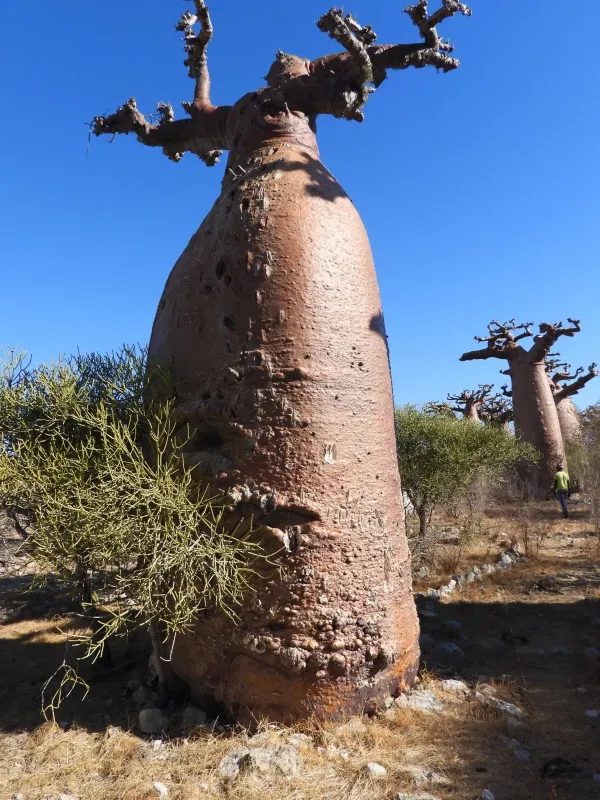
Description
Sowing dates
Propagation of Adansonia grandidieri is primarily achieved through seeds, as vegetative cloning remains experimentally difficult. Seeds possess a hard, protective coat that requires scarification—either chemical or mechanical—to break dormancy and allow water absorption.
Sowing should take place in a well-draining, sandy-loam substrate under consistent tropical heat, ideally maintaining temperatures above 25°C. Humidity must be managed carefully, as the high water content of the emerging radicle makes it susceptible to rotting in stagnant conditions.
Young seedlings grow rapidly in their first months but require significant exposure to full sun to prevent etiolation. Once established, the root system is sensitive to disturbance, so using deep, individual containers is recommended to facilitate future transplantation.
In nursery settings, providing a consistent light cycle and avoiding nitrogen-rich fertilizers helps in developing a sturdy, healthy stem structure. Patience is essential, as the growth rate varies depending on environmental stability.
Successful germination rates depend heavily on seed freshness and the precision of the scarification method used. Over-treating the seeds can destroy the embryo, whereas under-treating results in poor emergence rates.
Growing requirements
Adansonia grandidieri belongs to the Malvaceae family and is an iconic species endemic to Madagascar. It thrives in regions with a distinct climate, characterized by a long dry season followed by a period of heavy rainfall, which allows the tree to store water within its massive trunk.
Soil requirements are relatively specific: the tree demands excellent drainage and a loose soil structure. It cannot tolerate waterlogged conditions, which lead to rapid decay of its succulent wood and root rot.
As a heliophyte, the species requires intense, direct sunlight to sustain its metabolic processes. Growth in shaded environments leads to poor development and increased susceptibility to pests and diseases.
Thermal stability is a primary constraint, as the species is intolerant of frost. Any drop in temperature near or below freezing will severely damage the tissue of the tree, potentially causing irreversible structural failure.
In terms of agricultural management, irrigation should be carefully phased. During the dry season, the tree enters a state of physiological dormancy, and artificial watering should be minimized to mimic natural cycles.
Yield
The harvest of Adansonia grandidieri primarily involves the collection of its fruit, which contains a dry, nutritious pulp rich in vitamin C, fibers, and essential minerals. This pulp is highly valued in the global superfood market for its health benefits.
Seeds are another valuable byproduct, yielding oil used in cosmetic formulations and skin care products due to their emollient properties. Extraction processes typically involve separating the pulp, drying the seeds, and mechanical cold pressing.
Young leaves are occasionally consumed as a vegetable in local diets, though this is secondary to fruit and seed production. The overall yield is highly dependent on the tree’s age, as significant production generally does not begin until the tree reaches several decades of age.
The sustainable collection of these products is vital, as the species is categorized as endangered. Harvesting protocols must ensure that the reproductive cycle of the trees is not disrupted to allow for natural regeneration.
Market demand for organic, sustainably sourced baobab products has led to increased interest in managed wild harvesting, which provides economic incentives for the protection of these trees in their natural habitats.
Main diseases and pests
The most significant threat to Adansonia grandidieri is habitat loss driven by land conversion for agriculture. The transformation of native forests into fields limits the space available for new trees to mature, preventing the renewal of the population.
Fungal pathogens represent a major health risk, particularly when excess humidity persists around the base of the trunk. Such infections can weaken the structural integrity of the wood, making the tree susceptible to collapse.
Insect pests, such as various types of weevils, can infest the fruits and seeds, significantly reducing the viability of the produce. Managing these pests in wild conditions is challenging and often relies on natural predators.
Climate change poses a long-term risk by shifting precipitation patterns, which are critical for the flowering and pollination of the baobab. The loss of natural pollinators, such as fruit bats and lemurs, further complicates the reproductive success of the species.
Overgrazing by livestock is another concern, as young seedlings and saplings are frequently consumed or trampled, effectively preventing natural forest regeneration and narrowing the genetic diversity of existing populations.