
Curly parsley
Petroselinum crispum (Mill.) Nym. ex A.W. Hill var. tuberosum (Bernh.) Mart Crov.
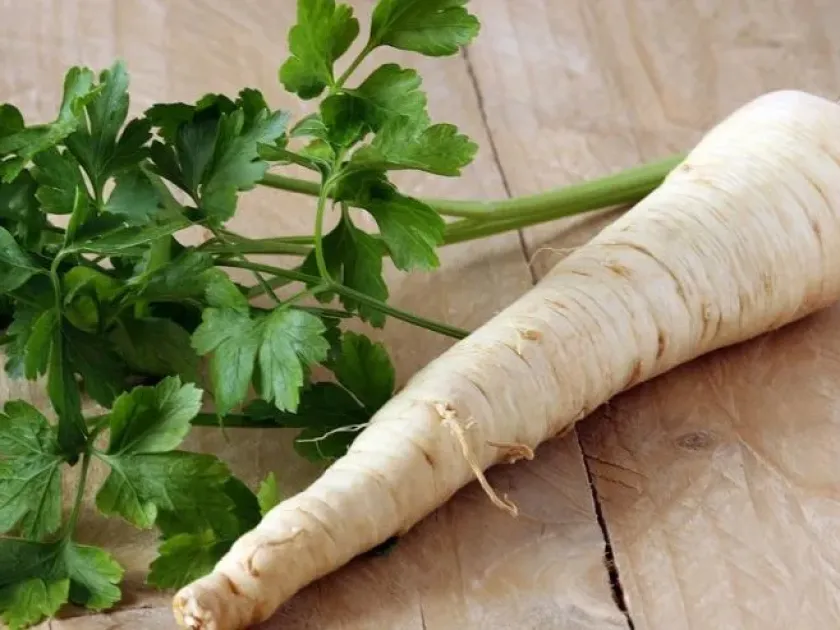
Description
Sowing dates
Curly parsley is a biennial herbaceous plant belonging to the Apiaceae family. During the first year of its life, the crop forms a rosette of beautiful, ruffled leaves, and in the second year, it produces a flowering stem for seed production.
Sowing in open ground is carried out early in spring as soon as the soil warms up to 3-5 degrees Celsius. Parsley seeds contain essential oils that slow down hydration, so it is recommended to soak or wash them in warm water to accelerate germination.
Late autumn sowing is also possible, performed in late October or early November, allowing the seeds to undergo natural stratification in the soil. This results in the earliest possible harvest of vitamin-rich greens immediately after the snow melts.
The seeding rate is approximately 0.5–0.8 grams per square meter with row spacing of about 20 centimeters. The seeds should be planted no deeper than 1.5–2 centimeters to ensure they can sprout easily through the soil surface.
The crop is known for its cold hardiness; seedlings can withstand short-term spring frosts down to minus 5-7 degrees Celsius. If necessary, additional sowing is carried out throughout the summer season every 2-3 weeks to ensure continuous harvest.
Growing requirements
Parsley prefers fertile, loose, and well-structured soil with a neutral pH level. The best predecessors for this crop are cucumbers, tomatoes, onions, or cabbage, as they leave behind plots that are well-fertilized and free of weeds.
The plant is photophilous but can tolerate partial shade very well. A lack of light often causes the stems to stretch and reduces the vibrant color of the curly leaf blades, which negatively affects the marketability of the product.
Requirements for moisture are high: if water is deficient, the leaves become coarse, lose their tenderness and aroma, and the growth of the crop slows down significantly. However, water stagnation in the root zone must be avoided to prevent root rot.
For organic enrichment, it is recommended to apply humus or compost during autumn tilling, avoiding fresh manure. Excess nitrogen in the soil can lead to the accumulation of nitrates in the leaf mass.
To ensure optimal crop development, it is necessary to keep the soil weed-free. Regular loosening of the rows provides oxygen to the roots and helps retain moisture in the lower soil horizons.
Yield
The average yield of curly parsley, under proper cultivation technology, ranges from 1.5 to 3 kilograms of marketable greens per square meter per season. This figure depends heavily on the variety, cutting frequency, and the general level of agrotechnology.
The highest yields are obtained through multiple cuts, which stimulate the regrowth of new greens from the growth point. It is crucial to harvest correctly without damaging the central bud to ensure the subsequent leaf development.
The use of modern hybrids allows for significant increases in yield and improved uniformity of the plants. High-quality seeds have high germination energy, ensuring a density of 60-80 plants per linear meter.
To increase output, apply mineral fertilizers after every major harvest. It is optimal to use balanced formulas containing micronutrients that promote rapid recovery of the vegetative mass.
An important factor for success is the timely control of pests, which can significantly reduce the volume of marketable produce. Damaged plants lose their appearance and are often unsuitable for fresh market sales.
Main diseases and pests
Among diseases, powdery mildew is the most dangerous, manifesting as a white coating on the leaves. Prevention involves crop rotation and the timely removal of plant residues from the area.
Rust and white spot disease (septoria) are also common, affecting the leaf apparatus in high humidity conditions. To combat fungal pathogens, fungicides are used strictly in accordance with regulations for green crops.
The main pest is the carrot fly, whose larvae can damage the root system and leaf stems. Using non-woven covering materials effectively protects the plantings from the fly laying eggs.
Aphids can suck juices from young shoots, causing deformation and curling of the leaves. For pest population control, it is recommended to use biological preparations that are safe for human consumption.
Slugs can cause mechanical damage to the leaves in rainy weather, significantly reducing the aesthetic value of curly parsley. Control measures include setting traps and keeping the beds free from dense weeds.
Harvesting
Harvesting parsley is done selectively by cutting fully formed leaves with stems at least 10-15 centimeters long. It is desirable to cut in the morning hours when the greens are maximally saturated with moisture.
After cutting, the product should be cooled immediately to prevent loss of turgor and yellowing of the leaves. When properly stored at low positive temperatures (1-2 degrees Celsius), parsley remains fresh for up to 10-14 days.
For long-term storage, the greens are dried in a dark, ventilated area or frozen in finely chopped form. Dried parsley retains its flavor and aroma throughout the entire winter period.
Industrial harvesting is often mechanized using special combines that cut the greens at a certain height. Afterward, the product undergoes sorting, washing, and packaging for distribution to retail chains.
It is important to remember the observance of sanitary standards during harvest, as greens are consumed without thermal processing. The use of clean tools and maintaining personal hygiene is the key to safe final products.