
Tmesipteris lanceolata
Tmesipteris lanceolata
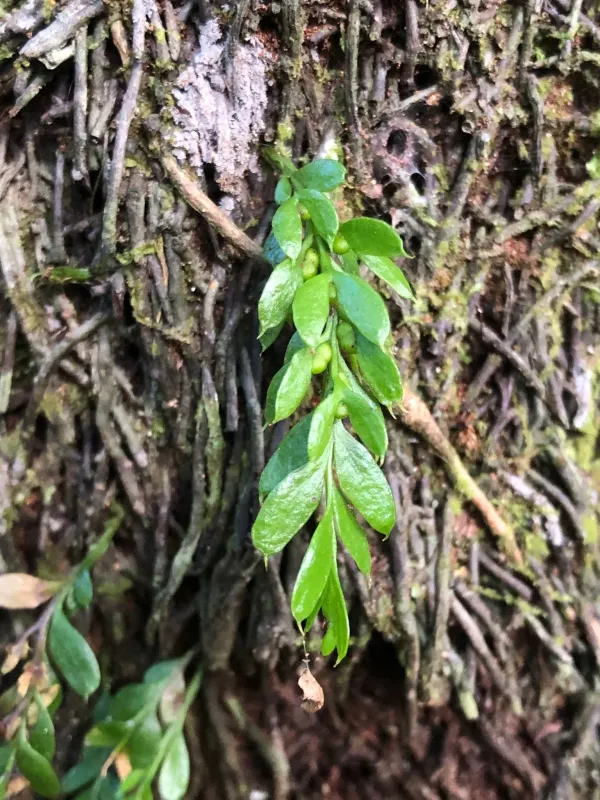
Description
Growing requirements
Tmesipteris lanceolata is a member of the Psilotaceae family, recognized as one of the most primitive groups of extant vascular plants. It serves as a fascinating example of botanical evolution, lacking true roots and leaves in the traditional sense.
Native primarily to the islands of New Caledonia and surrounding Pacific regions, this species is strictly adapted to tropical ecosystems. It survives as an epiphyte, typically anchoring itself onto the trunks of larger tree ferns in deep forest shadows.
Climatic requirements are rigorous, necessitating consistent high humidity and moderate tropical temperatures. The species cannot survive in arid environments and requires protection from frost and cold winds that are absent in its natural native range.
Soil requirements are essentially non-existent in the traditional agricultural sense, as the plant grows on organic debris trapped in bark crevices. In cultivation, it requires a specialized airy, humus-rich substrate that mimics the epiphytic environment.
Agricultural or laboratory management of Tmesipteris lanceolata focuses on maintaining high micro-climate stability. Propagation is challenging due to specific symbiotic relationships with soil microorganisms and the slow growth cycle of the gametophyte stage.