
Tmesipteris elongata
Tmesipteris elongata
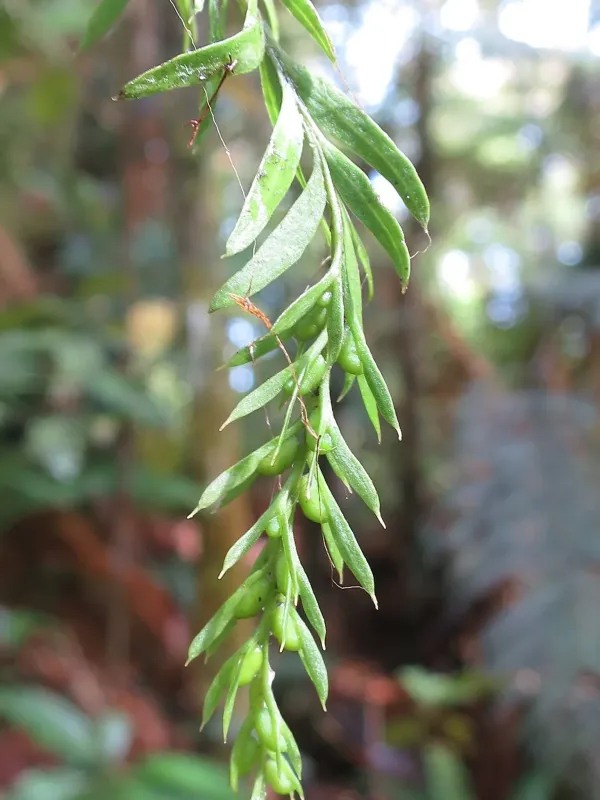
Description
Growing requirements
Tmesipteris elongata is a member of the Psilotaceae family, representing an ancient lineage of vascular plants. It is not classified as an agricultural crop and does not hold any significance for commercial cultivation or food production.
The species is native to the humid regions of Australia, New Zealand, and surrounding islands. It typically inhabits moist forest environments, thriving in microclimates with high atmospheric humidity and relatively stable, mild temperatures throughout the year.
In its natural habitat, Tmesipteris elongata commonly grows as an epiphyte, often found attached to the trunks of tree ferns. It relies on mossy surfaces or bark crevices to support its structure and absorb the necessary moisture and nutrients.
The plant requires a specific growing medium that mimics its natural substrate—highly organic, porous, and moisture-retentive. Because it lacks true roots, the plant is highly sensitive to the surrounding environment and is typically not viable in standard soil conditions.
Botanically, it is characterized by a dichotomously branching stem system and microphyllous leaves. Its reproductive process involves the production of spores within specialized structures called synangia, located along the stems, which is a key trait of the Psilotaceae family.