
Tillandsia xerographica
Tillandsia xerographica
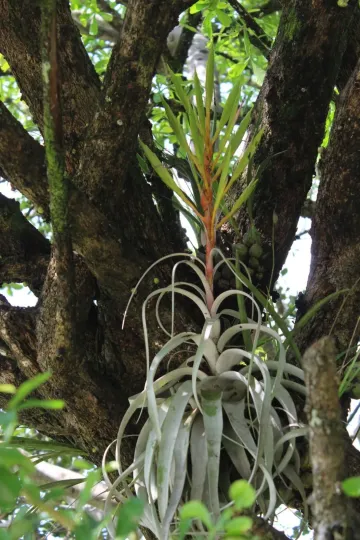
Description
Growing requirements
Tillandsia xerographica is a striking epiphyte species belonging to the Bromeliaceae family. Native to the dry regions of Central America, this plant has evolved to thrive in arid environments with very little annual rainfall, making it a highly specialized xerophyte.
As an obligate epiphyte, it does not grow in soil. It anchors itself to tree branches using its root system, while its leaves are covered in specialized structures called trichomes. These trichomes are responsible for absorbing water and nutrients directly from the air and atmospheric moisture.
Cultivation requires bright, indirect light to maintain the plant's characteristic silvery-grey color. High-intensity direct sunlight can scorch the leaves, while low light conditions will cause the plant to lose its compact, sculptural form and turn a dull green.
The optimal temperature range for the xerographica is between 18°C and 28°C. It prefers a humid environment but requires excellent air circulation to prevent moisture from becoming trapped in the core of the rosette, which is critical for its health.
Irrigation should be performed by misting or soaking the plant once or twice a week, depending on ambient humidity. It is imperative to invert the plant after watering to allow all excess moisture to drain away, preventing rot.
Main diseases and pests
The most significant threat to Tillandsia xerographica is rot caused by standing water in the leaf axils. If the core of the plant remains wet for too long, the plant will succumb to fungal infections very quickly.
Pests such as mealybugs and scale insects are common problems. Because the leaves grow in a tight rosette, these pests can be difficult to eradicate; manual removal or the use of mild horticultural oils is recommended.
Hard water is a silent killer for this species. Minerals and salts found in tap water can clog the trichomes, effectively choking the plant by preventing it from absorbing moisture and carbon dioxide.
The plant may be susceptible to fungal blight if kept in poorly ventilated, overly damp rooms. Proper airflow is not just a preference but a survival requirement for this specific type of air plant.
Always monitor the tips of the leaves for signs of stress or browning. While the outer tips may brown naturally due to aging, widespread browning or limp leaves are indicators of improper watering or pest infestation that need immediate attention.