
Tillandsia butzii
Tillandsia butzii
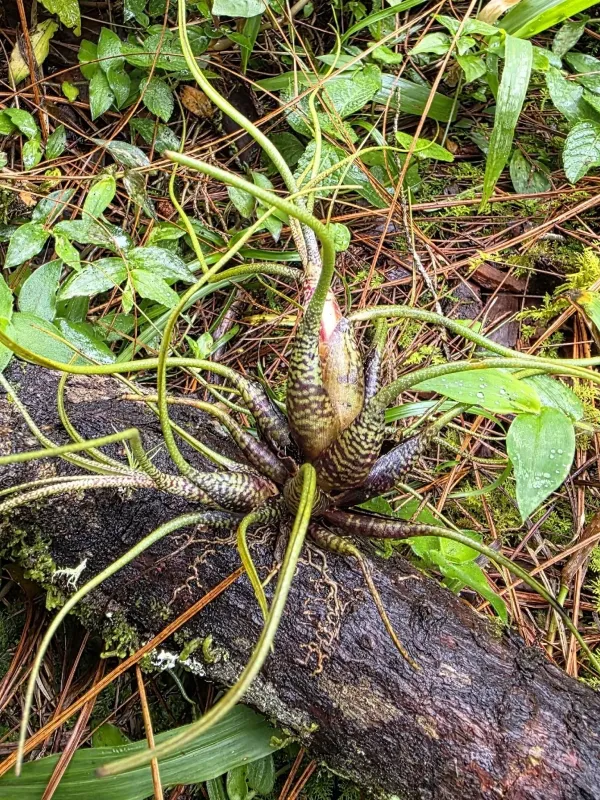
Description
Growing requirements
Tillandsia butzii is a perennial epiphytic plant belonging to the Bromeliaceae family. Native to the tropical forests of Central America, including Mexico, Guatemala, and Panama, this species naturally thrives in high-canopy environments, attaching itself to tree branches and bark.
Botanically, it features a unique bulbous base formed by its tightly curled, narrow, and dark-spotted leaves. The plant is covered in specialized microscopic scales known as trichomes, which are essential for absorbing moisture and nutrients directly from the humid forest atmosphere.
To cultivate this species successfully, one must maintain high relative humidity, ideally between 60% and 80%. Proper air circulation is just as critical as humidity, as it mimics the natural wind movement in tropical habitats and prevents the accumulation of stagnant water in the leaf base.
Lighting requirements involve bright, indirect light. Direct sun exposure should be strictly avoided, as it can cause dehydration and severe burns to the leaf tissues, significantly reducing the plant's ornamental value and physiological health.
The cultivation technique centers on an effective watering schedule. Watering is best performed by misting or submerging the plant for 15–20 minutes weekly, followed by thorough drying. Ensuring the base of the plant dries completely within a few hours is vital to prevent root and crown rot.
Yield
Tillandsia butzii serves a primary role in the ornamental and interior design sectors. It is highly sought after for terrariums, mounted displays, and vertical gardens, where its distinct, twisted morphology adds significant aesthetic value to modern botanical installations.
While the plant does not yield food crops, its commercial value is driven by its popularity among indoor plant enthusiasts and specialized nurseries. Specimens that are actively blooming with their characteristic violet flowers command higher prices in the marketplace.
Mass propagation is achieved vegetatively by separating offsets, often called "pups," that grow from the base of the mother plant after flowering. With proper environmental control in a greenhouse setting, breeders can optimize the production cycle to yield healthy, consistent inventory.
Growth rates and overall vigor are improved by the application of specialized water-soluble fertilizers for bromeliads. These are typically applied as a dilute foliar spray, ensuring the plant receives necessary micro-nutrients without causing salt buildup on its delicate leaf structures.
The long-term sustainability of this crop depends on maintaining a consistent growth environment. Since these plants are slow-growing, producers prioritize quality of care over volume, ensuring that each specimen reaches maturity with its signature coloration and structural integrity intact.
Main diseases and pests
Common pests affecting Tillandsia butzii include mealybugs and scale insects. These pests often congregate at the base of the leaves where moisture may linger. Regular physical inspection and gentle cleaning with a damp cloth or mild insecticidal soap are recommended for early detection.
Fungal infections and rot are the most frequent causes of plant loss, typically resulting from overwatering or inadequate drying conditions. If a plant shows signs of darkening or mushy tissue at the base, it must be removed from moisture and treated with a systemic fungicide.
Spider mites can become a problem in environments with low humidity, particularly during winter months. These pests cause the leaves to lose their healthy texture and become stunted. Consistent misting and good ventilation are the most effective non-chemical deterrents against these mites.
Hard water is detrimental to the plant's health, as it causes mineral salts to clog the trichomes. Over time, this restricts the plant's ability to absorb water, eventually causing the plant to wither and lose its characteristic vibrant appearance.
Environmental stress, such as sudden cold drafts or extreme temperature fluctuations, can lead to leaf senescence and susceptibility to secondary infections. Maintaining a stable climate is the single most important factor in protecting the health and longevity of this epiphytic species.