
Tau-saghyz
Takhtajaniantha tau-saghyz
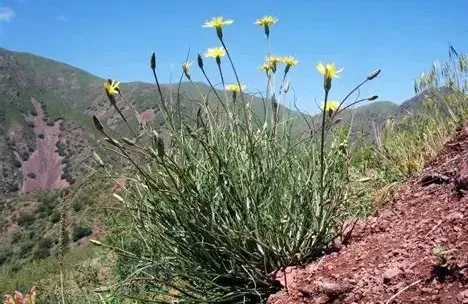
Description
Sowing dates
Tau-saghyz is a perennial herbaceous plant belonging to the Asteraceae family. The crop is primarily established through seeds, which often require cold stratification to improve germination rates in field conditions.
The optimal sowing time is early spring, immediately after snowmelt, when the soil retains sufficient moisture. Early establishment allows the plants to develop before the onset of summer drought.
Seeds are sown at a shallow depth, typically 1–2 centimeters, due to their small size. Precision seeders are recommended to achieve uniform plant density across the field.
During the first years of growth, the crop develops slowly, focusing on forming a rosette of leaves and a robust taproot system. It is in these roots that the plant accumulates its primary value: natural rubber.
Cultivation technology requires strict weed management to prevent competition during the initial growth stages. Inter-row cultivation is essential to maintain soil aeration and promote healthy root expansion.
Growing requirements
This crop has specific environmental requirements rooted in its native habitat within the mountains of Kazakhstan. Tau-saghyz prefers loose, well-drained soils with a neutral to slightly alkaline pH.
The plant exhibits high resistance to drought due to its deep root system. However, moderate moisture during critical growth phases is necessary to maximize rubber yield and biomass production.
The ideal climate features a continental pattern with cool, moist springs and hot, dry summers. Such conditions promote the metabolic processes necessary for rubber synthesis.
Soil compaction must be avoided, as the root system requires significant oxygen supply for proper development. Heavy clay soils prone to waterlogging are unsuitable for commercial production.
Fertilization should be managed carefully; excessive nitrogen can promote excessive foliage growth at the expense of rubber accumulation in the roots. Balanced nutrient application is preferred.
Yield
The primary economic use of Tau-saghyz is the extraction of high-quality natural rubber. The plant is considered a promising alternative source of raw material for the rubber industry.
The percentage of rubber content in the roots can reach significant levels with proper management. Rubber accumulation occurs gradually, typically peaking by the third or fourth year of the plant's life.
Yield is measured by the mass of harvested and dried roots per hectare. Depending on plant density and soil fertility, productivity varies significantly across different cultivation sites.
In addition to rubber, the plant has potential applications in the development of bio-polymers. Research highlights the high elasticity and purity of the latex extracted from the plant's sap.
Economic viability depends heavily on the mechanization of root harvesting and the efficiency of the extraction processes used to separate the rubber from plant tissues.
Main diseases and pests
Fungal diseases affecting the root system are the most common threats to Tau-saghyz, especially in poorly drained soils. Excess moisture can trigger root rot, leading to plant loss.
Insect pests that attack the leaf rosette during spring are significant threats. Damage to the foliage inhibits photosynthesis, thereby reducing the plant's ability to store resources in the roots.
In large-scale production, wireworms can cause substantial damage to young root systems, leading to gaps in the crop stands and reduced yields.
Strict crop rotation is the most effective management strategy for preventing disease and pest buildup. Avoid planting Tau-saghyz on the same land for consecutive years.
Preventive measures include the use of high-quality, treated seed stock and early-stage fungicide applications if signs of local infection appear.
Harvesting
Harvesting takes place once the plants reach full maturity, when rubber concentration in the roots is at its peak. This usually occurs no earlier than the third year after planting.
Mechanical harvesting equipment specifically designed for taproot crops is used to extract the roots from deep soil layers with minimal raw material loss.
Following extraction, the roots must be thoroughly cleaned of soil, dried, and sorted. Proper drying rates are crucial to prevent the degradation of the rubber content and other organic compounds.
Care must be taken during the harvesting process to avoid physical damage to the root system, which can complicate the extraction of the latex.
Once the harvest is complete, the field should undergo deep plowing to remove remaining residues and prepare the soil structure for subsequent crop rotation cycles.