
Fiddleneck phacelia
Phacelia tanacetifolia Benth.
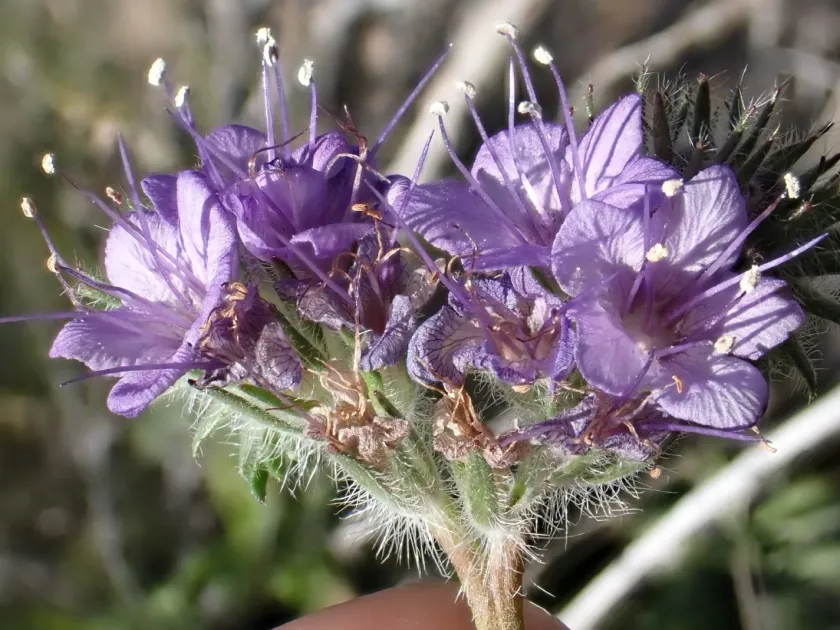
Description
Sowing dates
Phacelia tanacetifolia is remarkably cold-tolerant, allowing for very early spring sowing as soon as soil conditions permit. It thrives in cool weather, making it an excellent early-season crop for various agricultural regions.
For honey production purposes, staggered sowing is recommended. By planting seeds every 2–3 weeks, farmers can ensure a continuous supply of flowers throughout the season, maximizing the pollination window and nectar collection.
Seed depth should be shallow, ideally around 2 centimeters. Because the seeds require light to germinate effectively, deep burial significantly reduces emergence rates and compromises the overall density of the stand.
Seeding rates typically range from 8 to 12 kilograms per hectare. When broadcasted, ensuring uniform coverage is crucial to allow the crop to outcompete weeds during the initial rapid growth phase, which is a major advantage of the species.
As a catch crop, it can be sown immediately following cereal harvesting. Its fast-growing nature allows it to establish quickly and accumulate significant biomass before the arrival of autumn frost, providing essential soil protection.
Growing requirements
Phacelia belongs to the Hydrophyllaceae family and is adaptable to a wide range of soil types. It performs exceptionally well on light, sandy soils as well as loam, provided there is adequate drainage and initial moisture.
Sunlight is a primary requirement for success. The plant exhibits optimal nectar secretion only under full sun exposure. In shaded areas, the plants become leggy and produce significantly fewer flowers, reducing their value for apiaries.
While known for its drought tolerance, the crop requires consistent soil moisture during germination to ensure uniform emergence. Once established, the deep root system allows it to persist through drier conditions.
The plant is highly sensitive to waterlogging. Excessive moisture in the root zone can lead to rapid decay and poor growth performance. Therefore, site selection should prioritize well-drained soils to avoid negative outcomes.
Phacelia is often used in soil improvement programs. Its dense root network physically breaks up compacted soil, improving porosity and water infiltration for subsequent crops in the rotation cycle.
Yield
When grown as a green manure, the biomass yield can reach between 20 to 40 tons of fresh matter per hectare. This organic matter serves as a potent nitrogen-rich fertilizer that enhances soil structure and fertility.
As a nectar source, it is unparalleled in many regions, capable of producing 300 to 500 kilograms of honey per hectare under optimal flowering conditions. This makes it a high-value asset for integrated apiary and farming operations.
Seed yields generally range from 500 to 1000 kilograms per hectare depending on weather conditions during pollination. The crop is cross-pollinated, so the presence of bees significantly improves seed set and total yield.
The economic impact is often cumulative. Beyond the primary produce, the reduced need for nitrogen-based fertilizers in subsequent crops contributes significantly to the overall farm profitability and sustainable land management.
Success in production is measured not only by immediate harvest metrics but also by the long-term improvement in soil health and the reduction in weed pressure for the following planting season.
Main diseases and pests
Fiddleneck Phacelia is generally resistant to most common plant diseases. However, in overly damp climates or dense stands, it may be susceptible to gray mold or powdery mildew, necessitating proper plant spacing.
Aphids can pose a challenge during the budding stage, particularly if the crop is stressed. Integrated pest management strategies should be employed to protect the pollinators that visit the flowers.
Crucifer flea beetles are sometimes a concern for emerging seedlings. Rapid establishment is the best defense against these pests, as the plant quickly grows beyond the stage where it is most vulnerable to damage.
Slugs may become an issue in wet, weed-heavy fields. Maintaining clean fields through regular management keeps slug populations low, protecting the crop from potential devastation in its early development.
The plant's natural ability to suppress weeds and inhibit certain soil-borne pathogens contributes to its status as a healthy, low-maintenance component in modern agricultural systems and organic farming practices.
Harvesting
For green manure, the crop should be mowed at the beginning of the full bloom stage. At this point, the plants have accumulated the maximum amount of nutrients without yet producing mature seeds that could become weeds.
After mowing, the biomass should be lightly incorporated into the top 10–15 centimeters of soil. This allows for rapid decomposition, effectively locking in nitrogen and organic matter for the next crop cycle.
Seed harvesting requires a two-stage approach. The crop is cut when the seeds in the lower portion of the flower stalks have darkened, then dried in the field before being threshed with minimal cylinder speeds.
Drying is a critical step, as seed moisture levels must be reduced to below 14% to ensure safe storage. High moisture can lead to rapid fungal growth and the loss of seed viability during the winter.
Storage should occur in a clean, cool, and dry environment. With proper care, the seeds maintain excellent germination potential for several years, making them a reliable resource for farm planning.