
Baccaurea motleyana
Baccaurea motleyana (Muell. Arg.) Muell. Arg.
Description
Sowing dates
Baccaurea motleyana, commonly known as Rambai, is a tropical fruit-bearing tree belonging to the Phyllanthaceae family. The plant is typically propagated either through seeds or vegetatively, with grafting being the preferred method for commercial orchards to ensure fruit quality and yield consistency.
When propagating from seeds, it is crucial to use fresh seeds because they lose their viability very quickly once removed from the fruit. Seeds should be planted immediately in a well-draining, nutrient-rich potting medium to facilitate successful germination.
Seedlings require a controlled environment with high humidity and consistent warmth. During the first few years, it is vital to protect the young trees from direct sunlight and harsh environmental conditions until they establish a strong root system.
Transplanting to the permanent location in the orchard should be done with extreme care to avoid disturbing the root ball. Planting density is an important consideration; trees should be spaced roughly 8 to 10 meters apart to accommodate the large, spreading canopy of mature specimens.
Orchard establishment requires long-term planning, as the tree is slow-growing initially. Providing adequate space and proper site preparation ensures that the tree can develop its extensive root system, which is essential for healthy long-term growth.
Growing requirements
Rambai thrives in wet, tropical climates where temperatures remain consistently high throughout the year. The tree is not cold-hardy and will suffer significant damage if temperatures drop significantly, making it restricted to tropical latitudes.
The ideal soil for Baccaurea motleyana is deep, fertile, and slightly acidic, with high organic matter content. Good drainage is non-negotiable; while the plant enjoys moisture, it will not tolerate waterlogged conditions which often lead to root decay.
Regular rainfall is vital for the tree's health. In regions with distinct dry seasons, supplemental irrigation must be provided to ensure the tree maintains its metabolic functions and fruit development cycles without stress.
Nutrient management involves applying well-rotted compost or balanced organic fertilizers during the active growing season. Mulching around the base of the trunk helps in moisture retention and stabilizes soil temperature, which supports the tree's shallow root system.
Protection from strong winds is necessary to prevent physical damage to the heavy fruit-bearing branches. Shelterbelts or windbreaks can be integrated into the orchard design to shield the trees and maintain a microclimate conducive to high yields.
Yield
The productivity of Baccaurea motleyana is significant once the tree reaches maturity. Grafted trees can start bearing fruit as early as 3 to 4 years post-planting, whereas seedlings take considerably longer, often up to 8 years.
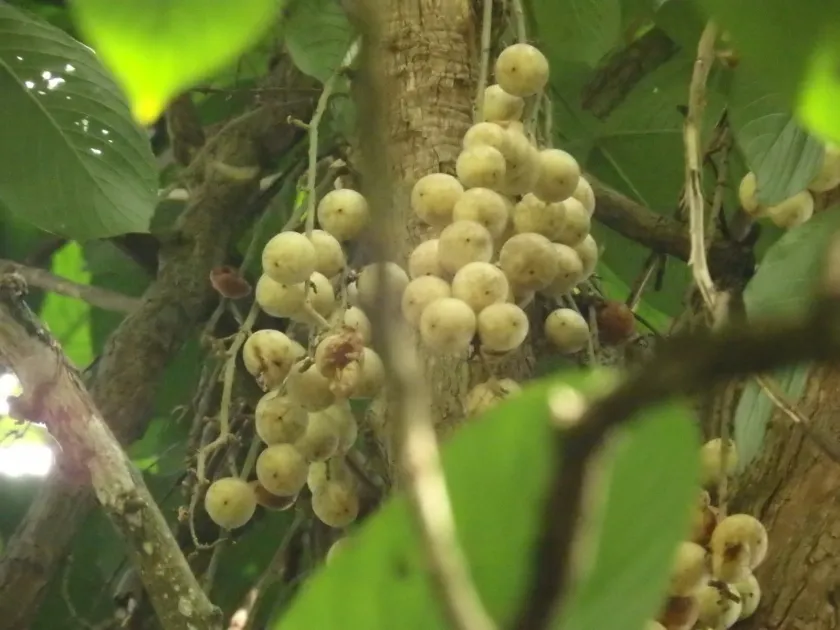
The fruits develop in dense clusters directly on the trunk and primary branches, a feature known as cauliflory. This characteristic is highly beneficial for manual harvesting as the fruit is concentrated in accessible parts of the tree.
A mature tree can produce an impressive annual yield of over 100 kilograms of fruit. The size of the yield is strongly correlated with tree vigor, soil fertility, and the availability of water during the crucial fruit-filling stage.
Harvested fruits vary in color from pale green to reddish-purple, indicating ripeness. The succulent, tangy-sweet pulp surrounding the seeds is the main edible portion and is highly prized for its unique flavor profile in regional cuisines.
Beyond local consumption, the fruit has potential for commercial processing. The ability to yield large volumes of fruit per tree makes it a valuable species for small-scale tropical fruit farming and diversifying horticultural production.
Main diseases and pests
The main threats to Rambai orchards include various fungal pathogens that flourish in high-humidity environments. Proper orchard hygiene, including the removal of deadwood and thinning the canopy, is essential to improve airflow and reduce infection risk.
Pests such as scale insects and mealybugs are common, feeding on the tree's sap and weakening its overall health. If left unmanaged, these pests can lead to stunted growth and reduced fruit quality, necessitating proactive monitoring.
Wildlife, particularly birds and bats, can cause substantial losses by consuming or damaging the ripe fruit clusters. Utilizing protective netting during the ripening season is the most effective way to safeguard the harvest from avian and mammalian predators.
Integrated Pest Management (IPM) practices are recommended to maintain ecological balance. Using organic horticultural oils or biological control agents helps manage pests without leaving harmful residues, which is vital for quality fruit production.
Regular tree inspection is a cornerstone of maintenance. Early detection of any nutrient deficiency or pathogen manifestation allows for swift corrective action, ensuring the longevity and productivity of the Rambai tree.
Harvesting
Harvesting should be performed with precision to ensure fruit longevity. The entire cluster is clipped from the tree, avoiding damage to the delicate outer skin of the berries, which can quickly lead to fermentation and spoilage if compromised.
Timing the harvest is critical; fruit must be harvested at the correct stage of physiological maturity. Because the fruit does not undergo significant ripening after being removed from the tree, selective picking of fully colored clusters is required.
Post-harvest handling requires immediate placement of the fruit in ventilated, shallow containers to prevent bruising and crushing. The fruit's high moisture content makes it susceptible to rapid degradation if piled too high during storage.
Temperature control is essential after the harvest. Keeping the fruit in a cool, shaded area helps to preserve its freshness and extends the shelf life, allowing more time for transportation to local markets.
For commercial distribution, the fruits are typically sold fresh or processed into preserves, jellies, or local drinks. Cold chain logistics are advantageous for maintaining the high quality of Rambai fruit intended for more distant markets.