
Phthirusa exilis
Phthirusa exilis
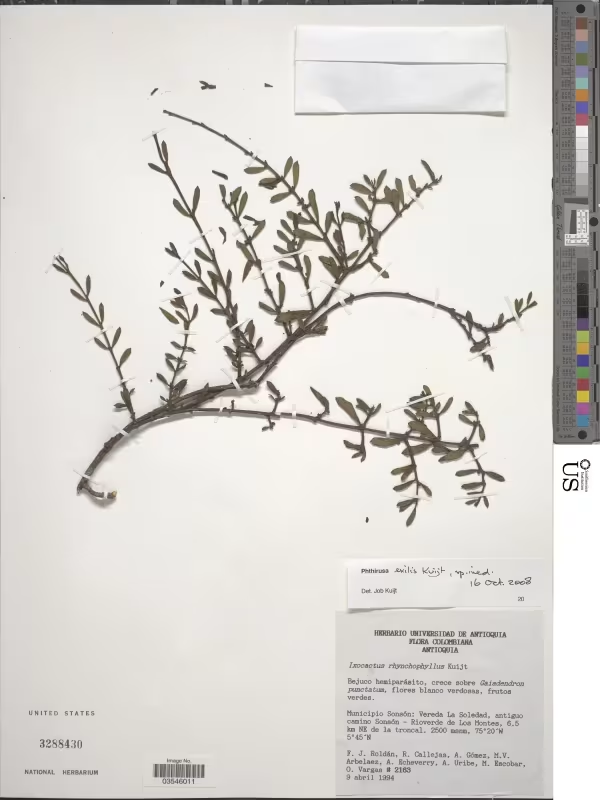
Description
Growing requirements
Phthirusa exilis is a perennial plant species classified within the Loranthaceae family, commonly known as the mistletoe family. As a semi-parasitic organism, it survives by anchoring itself to the branches of host trees, extracting water and nutrients through specialized structures called haustoria.
The native distribution of this species is primarily focused in Central and South America. It thrives in tropical rainforest environments where high humidity and consistent temperatures support the continuous growth of both the host trees and the parasite itself.
Unlike commercial crops, this species is not cultivated in agricultural systems. Its existence is tied to the canopy layer of forest ecosystems, where it functions as an epiphyte. It does not require root soil contact, as it gains all necessary moisture from the host plant's xylem.
The environmental requirements for Phthirusa exilis include a stable tropical climate with significant annual rainfall. It lacks cold tolerance, making it impossible to survive outside of tropical or subtropical zones where temperatures remain consistently above freezing year-round.
Ecologically, the plant prefers hosts with suitable bark structures that allow the initial attachment of seeds. Once the haustoria penetrate the host tissue, the plant becomes highly dependent on the host’s overall health for its own survival and photosynthetic efficiency.
Main diseases and pests
The primary threats to Phthirusa exilis are directly related to habitat destruction. Deforestation and the systematic clearing of primary tropical forests result in the loss of host trees, which is the sole environment where this plant can complete its life cycle.
Interspecific competition with other mistletoe species can impact the distribution of the plant within a single host tree. Stronger competitors can occupy favorable spots on the branches, limiting the space available for Phthirusa exilis to establish its connections.
Pests such as specialized insects and frugivorous birds influence the plant's life cycle. While birds are essential for seed dispersal, they also consume significant amounts of fruit, which can sometimes reduce the reproductive success of the local plant population.
Fungal pathogens represent a hidden danger, particularly when they colonize the haustorial attachment points. Such infections can restrict the flow of water and minerals from the host to the parasite, often leading to the eventual decline and detachment of the plant.
Conservation of tropical biodiversity is vital for the survival of this species. As its life cycle is strictly integrated into the host tree's existence, the loss of mature forest stands poses an irreversible threat to the local populations of this biological specialist.