
Pediastrum simplex
Pediastrum simplex
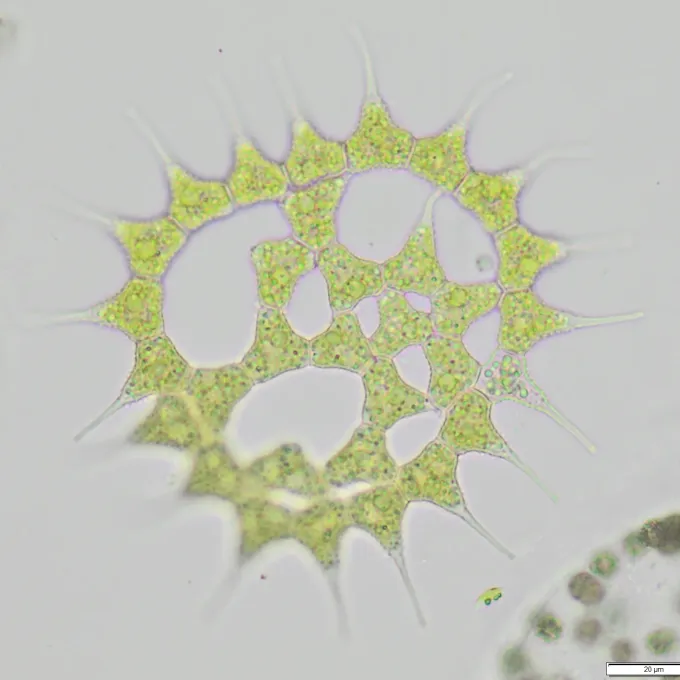
Description
Sowing dates
In natural conditions, Pediastrum simplex is not sown by humans, but in biotechnological production, cultivation begins with the transfer of an inoculum into sterile nutrient media. The process starts when the water temperature reaches +20...25°C, which is the optimal threshold for cell division.
To accelerate culture growth, special mineral solutions enriched with nitrogen and phosphorus are used to mimic eutrophic bodies of water. A crucial stage is maintaining the correct light regime, as the alga is a phototrophic organism.
Monitoring population density during the initial development phase helps avoid competition for nutrients. The optimal time for active reproduction is the period from late spring to mid-summer.
The use of specialized photobioreactors allows for the control of cultivation periods independently of external seasonal factors. Upon reaching peak density, the biomass undergoes stabilization.
The reproduction process occurs through the formation of zoospores, which create new daughter colonies within the mother cell. Under favorable conditions, this cycle repeats every few days.
Growing requirements
Pediastrum simplex belongs to the Hydrodictyaceae family and is a freshwater green alga. For normal metabolism, the organism requires water with a moderate level of mineralization and a neutral or slightly alkaline pH.
The culture is extremely sensitive to the level of dissolved oxygen and carbon dioxide content, which are key factors in photosynthetic activity. Intense lighting accelerates the formation of typical star-shaped colonies.
The temperature optimum for the species' development lies in the range of +18°C to +28°C. When temperatures drop below +10°C, metabolism significantly slows down, leading to the cells entering a dormant state or forming akinetes.
Requirements for water composition include the presence of phosphorus, potassium, and magnesium salts. In its natural range, the alga is most often found in stagnant or slow-moving waters where there are no sudden fluctuations in the hydrological regime.
Successful cultivation in artificial conditions requires constant aeration or stirring of the medium. This prevents cells from settling to the bottom and ensures uniform light access for the entire population.
Yield
The yield of Pediastrum simplex is estimated by the dry weight of biomass obtained per unit volume of nutrient medium. In industrial conditions, product output directly depends on light intensity and nutrient salt concentration.
By using flow-through cultivation systems, high cell density can be achieved without the risk of inhibition by metabolic products. Modern bioreactors allow for the production of significant volumes of raw material for aquaculture needs.
The efficiency of harvesting is determined by filtration or centrifugation methods of the suspension. Correct harvest timing allows for biomass with high protein and lipid content.
The scalability of this culture's production allows it to be considered a promising source of feed additives. Productivity indicators remain stable when lighting and temperature control protocols are followed.
In closed systems, yields can reach several grams of dry matter per liter of culture. This makes Pediastrum an effective tool in water resource bioengineering.
Main diseases and pests
The main threat to the Pediastrum population comes from virus-like agents capable of causing cell lysis. Mass infection can lead to a sharp drop in culture density within a few hours.
Pests in a broad sense include small rotifers and ciliates that actively feed on the algal cells. Controlling the number of these organisms is critical to maintaining culture purity.
The accumulation of toxic metabolites in the medium, such as excess ammonia, can lead to colony deformation and the death of a significant portion of the biomass. Regular replacement or cleaning of the nutrient solution eliminates this risk.
Lack of light or spectral inadequacy causes etiolation and a decrease in the photosynthetic ability of the cells. This weakens the population and makes it vulnerable to pathogens.
Parasitic fungi (chytrids) can also infect Pediastrum simplex colonies, causing their destruction. Prevention includes sterilizing the water supply and maintaining optimal sanitary conditions for equipment.
Harvesting
Harvesting of Pediastrum begins when the culture reaches the logarithmic growth stage. At this point, the biomass possesses the highest biological value and composition purity.
Step-wise filtration methods through sieves of various mesh sizes are employed. This allows for the separation of the target colonies from small contaminants and microorganisms.
After extraction, the suspension is concentrated via centrifugation. The resulting paste can be sent for immediate processing or frozen for long-term storage.
An important requirement is adherence to hygiene standards to prevent contamination by extraneous microorganisms. The harvesting process should take minimal time to maintain colony integrity.
The resulting raw material is often subjected to spray drying, which allows for the preservation of useful substances. The final product is used as a feed additive or component in fish farming.