
Creeping woodsorrel
Oxalis corniculata L.
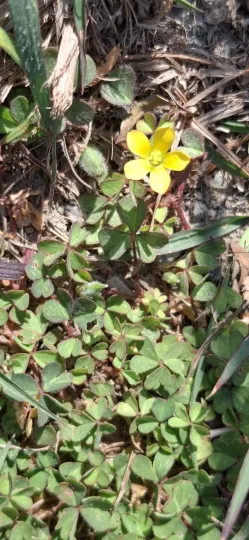
Description
Growing requirements
Creeping woodsorrel (Oxalis corniculata L.) is a member of the Oxalidaceae family. This perennial herb is widely recognized as a persistent weed that thrives in diverse agricultural environments, including greenhouses and orchards.
The plant exhibits high adaptability to various soil types, preferring moist and fertile environments. It demonstrates vigorous growth under both direct sunlight and partial shade, making it a highly competitive species in various crop systems.
Botanically, it features creeping stems that root at the nodes, allowing for rapid horizontal spread. The foliage consists of trifoliate leaves, which often display a distinct reddish or purple hue, and small yellow flowers that bloom throughout the season.
Reproduction is primarily achieved through seeds, which are expelled explosively from specialized capsule fruits, spreading over significant distances. This biological mechanism ensures the plant's colonization of new habitats.
Cultivation management is complicated by the plant's ability to survive in a wide range of temperatures. Effective management requires understanding its growth habits, particularly its efficient use of vegetative propagation through rooted stems.
Main diseases and pests
In agriculture, creeping woodsorrel is considered a problematic weed due to its aggressive growth, which crowds out desired crops. It competes effectively for essential resources such as water and nutrients in high-value agricultural zones.
The plant can harbor various pests and diseases that pose a risk to nearby economic crops. It is often a host for pathogens like rust fungi, which may transition from the weed to susceptible cultivars during favorable weather conditions.
Pest populations, including aphids and mites, often utilize woodsorrel as a reservoir. Control programs must account for the weed's role in the broader agro-ecosystem to prevent cross-infestation of crops.
Control methods include manual weeding, which must be thorough to remove all rooting stem fragments. If small pieces of the stem remain in the soil, they can regenerate into new, robust plants.
Chemical control involving selective herbicides is common in nursery management. However, due to the waxy nature of the leaves, surfactants are often required to improve the efficacy of post-emergence treatments.