
Bermuda buttercup
Oxalis pes-caprae L.
Description
Growing requirements
Bermuda buttercup (Oxalis pes-caprae L.) belongs to the Oxalidaceae family. Originally native to South Africa, it has become a pervasive invasive species in Mediterranean climates globally, often found in vineyards, orchards, and cultivated fields.
The plant is a perennial geophyte with a complex subterranean system of bulbs. This structure allows it to survive seasonal droughts and re-emerge rapidly when moisture becomes available, making it a highly resilient agricultural pest.
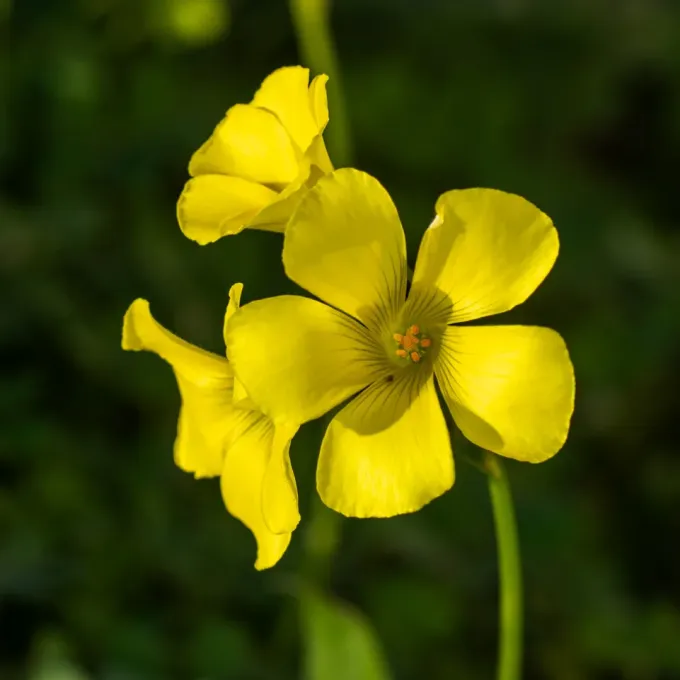
The botanical structure includes trifoliate, clover-like leaves and bright yellow funnel-shaped flowers. Its growth pattern is rapid, often creating a dense canopy that shades out smaller crops and competes aggressively for limited soil nutrients.
It thrives in loose, well-drained soils and is particularly problematic in areas with temperate winters. Since the plant is sensitive to severe frost, its distribution is largely restricted to regions where winter temperatures remain relatively mild.
Agricultural management is complex because the species primarily spreads via vegetative propagation. Even tiny fragments of the bulb system can develop into new plants, which often happens accidentally during soil cultivation practices.
Main diseases and pests
In agriculture, Bermuda buttercup is categorized as a noxious weed. Its ability to colonize large areas quickly results in significant yield losses in vegetables, cereals, and permanent crops by sequestering soil water and nitrogen.
Control is challenging due to the plant's tolerance to many standard post-emergence herbicides. Effective eradication often requires a long-term approach, focusing on the destruction of the bulbous root systems before they reach maturity.
Pests and pathogens show limited effectiveness against the Bermuda buttercup. The high concentration of oxalic acid in the leaves acts as a natural chemical defense, deterring most herbivores and keeping the plant population stable.
Disease pressure from common agricultural pathogens is negligible. The plant remains vigorous even under conditions that would stress or kill off many other competing weed species in the same field environment.
Integrated weed management remains the best strategy, utilizing a mix of solarization, deep plowing (where feasible), and highly targeted systemic herbicides to ensure the exhaustion of the plant's bulb reserves over several growth cycles.