
Cape sumach
Osyris compressa
Description
Growing requirements
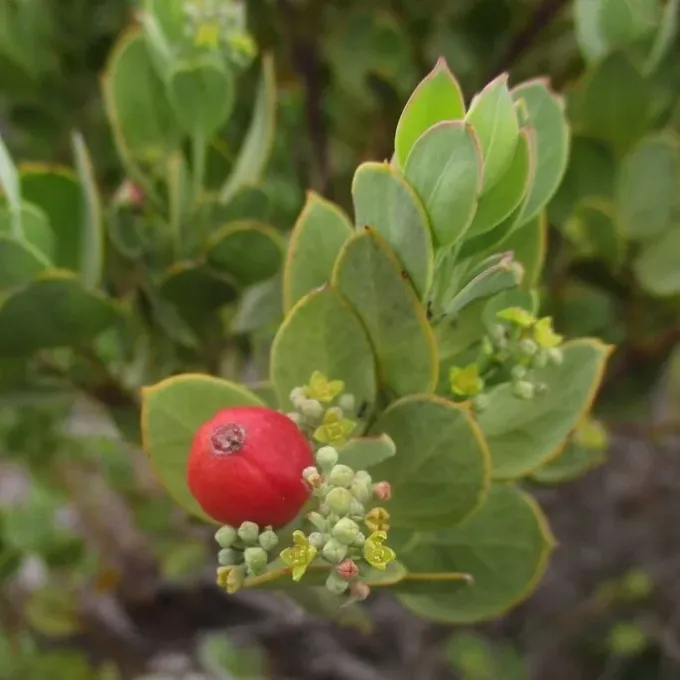
Cape sumach (Osyris compressa) is a distinctive evergreen shrub that belongs to the sandalwood family, Santalaceae. This plant is well-regarded for its hemiparasitic nature, meaning it establishes root connections with host plants to supplement its nutrient uptake, particularly in water-stressed environments.
Native to Southern Africa, this species thrives in diverse landscapes ranging from coastal dunes to arid mountain slopes. Its distribution is closely linked to its ability to survive in nutrient-poor, sandy soils where other plant species struggle to establish a stable root system and water supply.
Botanically, the plant is characterized by its flattened (compressed) stems and leathery, grayish-green leaves. These features are evolutionary adaptations that minimize transpiration, allowing the plant to remain green and physiologically active even during the harshest drought conditions of the African summer.
Cultivation requirements for this species are specific due to its semi-parasitic nature, making it unsuitable for traditional field crop systems. It prefers well-drained, sandy substrates with high exposure to sunlight. Propagation is typically achieved through seeds, often dispersed by birds that consume the fruit.
The economic utility of the species remains largely artisanal and local. The wood is occasionally used for small-scale woodworking due to its durability, and the berries are recognized as a food source in certain tribal traditions. Furthermore, its role as a hardy, drought-tolerant species makes it a subject of interest in ecological restoration projects.