
Greenheart
Ocotea rodiei (M. R. Schomb.) Mez
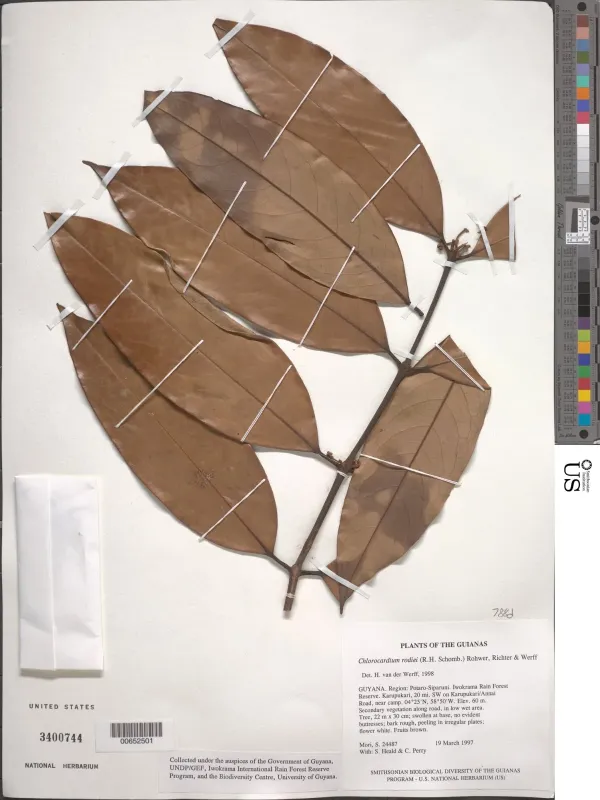
Description
Sowing dates
Greenheart (Ocotea rodiei) is not a conventional agricultural crop, but a slow-growing tropical hardwood native to the rainforests of Guyana and surrounding areas.
In its natural habitat, regeneration occurs through seeds that require moist, shaded soil conditions to germinate successfully on the forest floor.
Artificial propagation in nursery settings is challenging due to the short lifespan of the seeds, which must be planted immediately after collection to ensure viability.
Seedlings develop very slowly and are highly dependent on the protection of the existing canopy to shield them from direct and intense tropical sunlight.
Establishing new stands requires expert silvicultural intervention to replicate the complex environmental conditions of the primary tropical forest.
Growing requirements
As a member of the Lauraceae family, Greenheart thrives in humid tropical climates that experience high annual precipitation and consistent, warm temperatures.
The species prefers deep, well-drained, and nutrient-rich soils that maintain stable moisture levels throughout the different seasons of the year.
It is sensitive to soil compaction and dehydration, making it an excellent indicator species for the overall health of the tropical forest ecosystem.
The tree requires a microclimate characterized by high relative humidity, which is typically provided by the dense structure of the surrounding rainforest vegetation.
Any significant shift in local hydrological patterns can have a deleterious effect on the growth and recruitment rates of young Greenheart trees.
Yield
The primary economic output of this species is its highly prized timber, known for extreme density, exceptional strength, and natural durability.
Greenheart wood is renowned for its resistance to marine borers, rot, and fungi, making it the gold standard for marine construction and hydraulic engineering.
Key applications include the construction of dock pilings, jetties, sea walls, and lock gates, where timber is exposed to both water and extreme pressure.
Due to the long maturity period of the tree, commercial extraction must be carefully managed to ensure the long-term sustainability of the population.
The timber industry relies on strict certification programs to regulate the harvest of Greenheart, balancing economic demand with essential conservation efforts.
Main diseases and pests
The primary threat to Greenheart populations is the overexploitation of forest resources and the loss of natural habitat due to land-use changes.
Fungal pathogens and wood-rotting organisms can compromise the integrity of trees if they suffer mechanical injuries during selective logging operations.
Invasive pests and pathogens characteristic of the tropical biome may impact vulnerable young trees, hindering their successful transition to maturity.
Climatic volatility, including prolonged dry spells, negatively impacts the reproductive cycle and the seedling survival rates within natural stands.
Conservation strategies focus on strictly controlled management zones to prevent the degradation of habitats and to protect the remaining old-growth specimens.