
Napoleonaea heudelotii
Napoleonaea heudelotii
Description
Growing requirements
Napoleonaea heudelotii is a prominent member of the Lecythidaceae family, native to the tropical forests of West and Central Africa. This species thrives in hot, humid environments, typically found in the understory of dense equatorial forest ecosystems.
The plant requires a strictly tropical climate with consistent temperatures averaging between 22 and 30 degrees Celsius. It lacks cold hardiness and must be protected from any drop in temperature below 15 degrees Celsius to ensure healthy vegetative development.
Cultivation requires deep, fertile, and well-drained soils that are rich in organic matter. A slightly acidic to neutral soil pH is ideal, as it facilitates the absorption of nutrients necessary for the rapid growth of this tropical shrub or small tree.
Water management is vital for the plant, as it demands high atmospheric humidity and constant soil moisture. Prolonged drought can severely impact its growth and flowering cycle, making regular irrigation essential in areas with seasonal rainfall patterns.
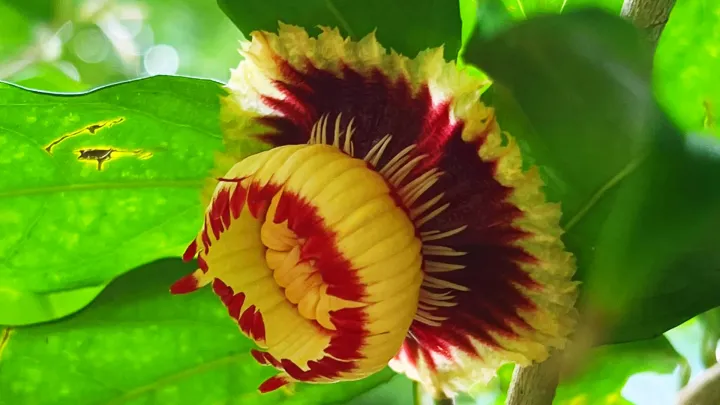
The botanical structure of the plant is distinctive due to its complex and showy flowers, which possess a radial arrangement of stamens and colorful petals. These morphological traits are evolutionary adaptations to attract specific tropical pollinators in the dense forest environment.
Yield
The fruit of Napoleonaea heudelotii is edible and serves as a local food resource. The berries contain a fleshy, pulp-rich interior that is appreciated for its unique flavor profile, making it a valuable non-timber forest product for local communities.
Beyond its culinary utility, the wood of the plant is utilized in small-scale crafts and tool making. Known for its durability, it is often shaped by local artisans into domestic utensils and decorative objects that demonstrate the plant's multifaceted utility.
Ethnobotanical records indicate that extracts from the bark and roots are used in traditional medicine to address various inflammatory conditions. While these practices are widespread, ongoing research continues to explore the phytochemical properties of this species.
Yield capacity remains limited because the plant is primarily harvested from wild populations rather than industrial plantations. However, interest in incorporating the species into sustainable agroforestry systems is growing due to its environmental adaptability.
Future agricultural efforts may focus on propagating high-yielding varieties to stabilize production. As global interest in exotic tropical crops increases, Napoleonaea heudelotii represents a potential niche crop for specialized tropical botanical gardens and sustainable farms.