
Muilla transmontana
Muilla transmontana
Description
Growing requirements
Muilla transmontana is a perennial bulbous plant belonging to the Asparagaceae family. It is natively distributed in the arid regions of North America, particularly within the basin and range provinces of the Western United States. This plant is well-adapted to environments with prolonged dry seasons.
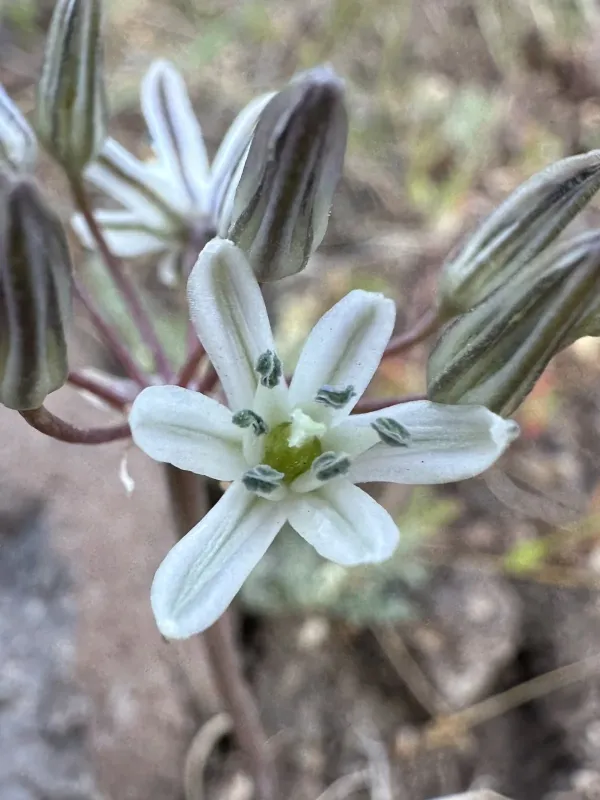
Botanically, it features a tunicated bulb that acts as a reservoir during dormancy. The foliage is typically sparse and grass-like, designed to endure high evapotranspiration rates. The inflorescence consists of small, starry flowers that emerge during the short spring window when moisture is available.
In cultivation, the species demands coarse-textured, well-draining soils. It is highly intolerant of heavy clay or loam that retains water, as these substrates lead to immediate root and bulb rot. Sandy or gritty mixtures with added mineral components are essential for success.
The climate requirements involve a cycle of cool, wet springs followed by hot, arid summers. In a garden setting, it is imperative to cease irrigation entirely once the foliage begins to yellow to mimic the natural ecological signal for dormancy.
The economic and horticultural value of Muilla transmontana lies in its utility for xeric landscapes and specialist bulb collections. It provides an excellent option for rock gardens where standard horticultural bulb species would fail due to excess irrigation or nutrient-rich soil.
Main diseases and pests
The primary threat to the health of Muilla transmontana is the presence of fungal pathogens such as Fusarium and Rhizoctonia. These occur almost exclusively when the soil remains moist for extended durations during the summer months.
Pests such as bulb mites are a persistent issue in horticultural collections, causing the degradation of the basal plate. Infestations often go unnoticed until the plant fails to emerge in the following spring, leading to total loss of the specimen.
Invasive weed species can rapidly outcompete this slow-growing plant. Regular weeding is mandatory, though it must be done carefully to avoid mechanical damage to the shallow-seated bulbs.
Small mammals, including voles and ground squirrels, pose a threat by consuming the bulbs. Implementing physical barriers, such as wire mesh baskets for planting, is a common practice among collectors to protect the bulbs from digging pests.
Nutrient deficiency is rarely an issue, but improper pH levels can inhibit nutrient uptake. Periodic monitoring of soil acidity and preventing excessive organic matter accumulation is crucial for the long-term vitality of the bulb population.