
Yellow bird's-nest
Monotropa hypophegea
Description
Growing requirements
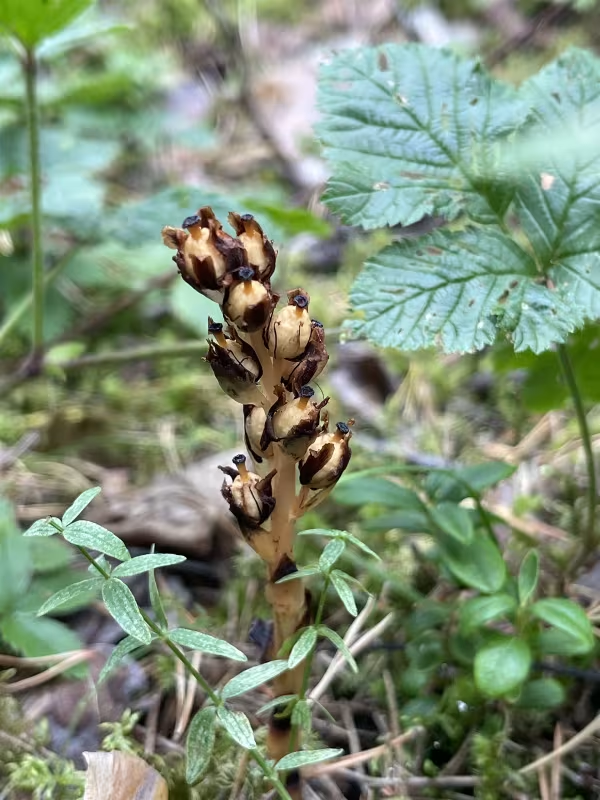
Yellow bird's-nest (Monotropa hypophegea) is a fascinating perennial plant belonging to the Ericaceae family. Unlike most plants, it lacks chlorophyll, which gives it a pale, yellowish appearance and makes it unable to perform photosynthesis.
The plant thrives through a mycoheterotrophic lifestyle. It derives all its nutrients from a symbiotic relationship with fungi, which in turn are connected to the roots of forest trees, particularly the European beech. This complex underground network is essential for its survival.
The habitat requirements are extremely specific, favoring dense, shaded woodlands with deep leaf litter. It cannot be cultivated as an agricultural crop because it relies entirely on a stable, established forest ecosystem and its existing fungal networks.
It prefers cool, temperate climates with consistent soil moisture. The plant is typically found in old-growth forests where the soil is rich in organic matter and the microclimate remains stable throughout the growing season.
Regarding agrotechnical practices, there are none for this species as it is not a domesticated plant. Attempts to transplant or cultivate it outside of its natural habitat have consistently failed, highlighting its role as a bio-indicator of healthy, undisturbed forests.
Main diseases and pests
The primary threat to the yellow bird's-nest is habitat destruction caused by forestry activities. Clear-cutting and forest thinning disrupt the mycorrhizal networks that the plant relies on for nutrient uptake from its host trees.
Changes in soil hydrology are also detrimental. Any activity that causes the soil to dry out or alters its chemical composition will likely lead to the decline or local extinction of the species.
Mechanical damage to the soil, such as compaction from heavy machinery or high foot traffic, can crush the underground systems. Since the plant is non-photosynthetic, any damage to the host-fungus-plant chain is irreversible.
The species does not face typical agricultural pests or diseases. Its reliance on specific fungi and forest conditions makes it immune to conventional crop pathogens but highly sensitive to any shift in the ecological balance of its home environment.
Climate change poses a long-term threat as shifting temperature and rainfall patterns affect the survival of the mycorrhizal fungi. If the symbionts are affected, the survival of the yellow bird's-nest is immediately jeopardized.