
Mitrophyllum grande
Mitrophyllum grande
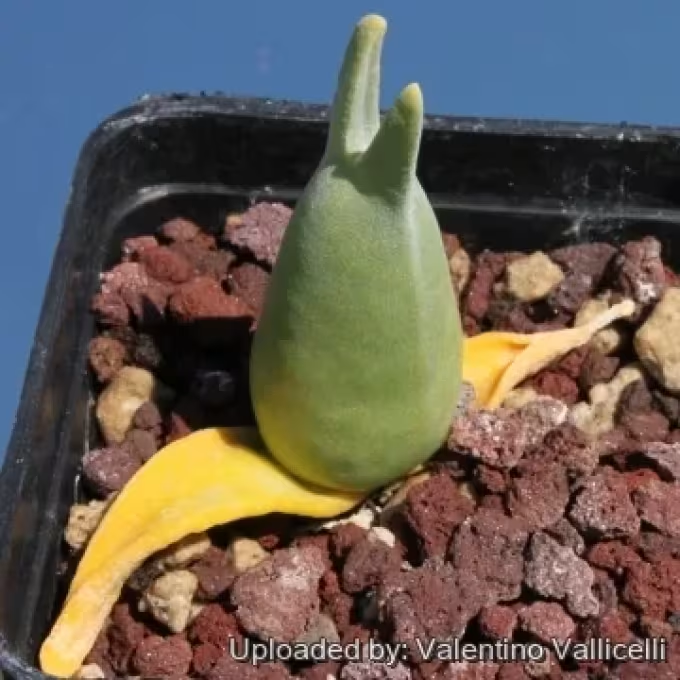
Description
Growing requirements
Mitrophyllum grande is a fascinating succulent species belonging to the Aizoaceae family. Native to the arid regions of Southern Africa, this plant has evolved distinct morphological adaptations to survive in extreme desert environments with very low rainfall.
The plant exhibits a remarkable life cycle characterized by leaf dimorphism. During the wet season, it produces large, succulent leaves, while in the dormant period, the leaves fuse together to form a protective sheath that preserves moisture.
Cultivation requires conditions that closely mimic its natural habitat. Full sun exposure is non-negotiable; inadequate lighting results in etiolation, where the plant loses its characteristic compact shape and becomes structurally weak.
Soil composition must be inorganic and exceptionally free-draining. A professional mix should incorporate high amounts of porous material like coarse sand, volcanic rock, or perlite to facilitate rapid evaporation and prevent moisture retention around the base.
Watering strategy is the most critical aspect of maintenance. It must follow a strict seasonal rhythm: providing water only during the growing phase while maintaining absolute dryness during the dormant season to replicate the natural drought cycle.
Main diseases and pests
The primary threat to Mitrophyllum grande is fungal rot triggered by excessive humidity or waterlogged substrate. Once rot sets in, it spreads rapidly through the succulent tissues, making early detection and prevention essential for survival.
Mealybugs are the most common pests affecting this species. They frequently colonize the crevices between the fused leaves, where they are difficult to reach with standard contact insecticides, necessitating systemic control methods.
Root damage can also be caused by various soil-borne pathogens or nematodes if the growing medium is not adequately sterilized. Using high-quality, professional-grade grit and sterile pots significantly reduces the risk of infestation.
Environmental stress often manifests as shriveled or discolored leaves. While some leaf shrinkage is normal during dormancy, unexpected softening usually indicates that the root system is compromised by either decay or dehydration.
Maintaining adequate air circulation in the growing environment is essential to prevent the development of mold. Proper ventilation ensures that surface moisture evaporates quickly, keeping the epidermis of the plant healthy and resistant to infections.