
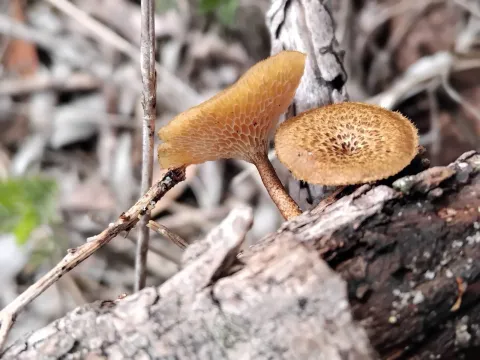
Shiitake
Lentinus
Shiitake (Lentinus edodes), a member of the Marasmiaceae family, is a wood-decaying fungus that thrives on hardwood logs or lignocellulosic-based artificial substrates.
What the section contains


Shiitake
The cultivation process begins with the inoculation of the substrate with pure culture mycelium, which must be carried out in a sterile environment to prevent contamination.
Incubation is the first critical phase, lasting from 60 to 120 days, during which the mycelium colonizes the substrate, turning the blocks from white to a characteristic brown color as they mature.
For large-scale operations, sawdust-based blocks are standard, whereas log cultivation remains a popular choice for outdoor or low-tech, traditional farming methods.
Selecting the right strain is vital, as different varieties are optimized for specific temperature ranges, ranging from cold-weather to warm-weather cultivars.
Shiitake requires high humidity levels between 80% and 90% throughout the fruiting phase, which can be maintained through automated misting systems.
Temperature control is essential: while mycelium grows best at +20°C to +25°C, fruiting is typically triggered by a temperature drop to +12°C to +16°C.
Substrate enrichment with cereal bran or other nitrogen-rich supplements is necessary to achieve high biological efficiency and large, fleshy mushroom caps.
Proper airflow is non-negotiable, as shiitake mushrooms are sensitive to CO2 levels; high concentrations of carbon dioxide result in long, spindly stems and underdeveloped caps.
The growing area must be kept clean, with adequate light exposure—typically around 500-1000 lux—to ensure proper cap pigmentation and structural integrity.
The expected biological efficiency of shiitake production typically ranges from 20% to 30% of the dry weight of the substrate over a production cycle of several flushes.
Yield is highly dependent on the quality of the substrate and the environmental consistency maintained during the fruiting stages of the mushroom life cycle.
Growers often manage 3 to 4 distinct harvest waves per block, with each subsequent flush generally yielding slightly smaller mushrooms than the first one.
Effective management includes the "soaking" technique, where blocks are submerged in cold water between flushes to rehydrate the substrate and stimulate the next harvest.
Under optimal conditions, well-managed farms can reach significant production volumes, making shiitake one of the most commercially viable gourmet mushroom species.
Fungus gnats are the most common pests in shiitake farms, as they feed on mycelium and can introduce bacterial or mold infections into the growing environment.
Trichoderma species, known as green mold, are the primary competitors and pathogens that quickly overwhelm blocks if the initial inoculation or substrate sterilization fails.
Bacterial blotch, characterized by dark, slimy spots on the caps, is often caused by excessive surface moisture or insufficient ventilation during the final stages of growth.
Integrated Pest Management (IPM) is essential; it involves routine cleaning, environmental monitoring, and the use of physical barriers to prevent insect entry.
Since chemical control is rarely an option due to food safety standards, rigorous sanitation remains the only effective strategy for disease prevention.
Harvesting should occur when the mushroom cap is still 70-80% open, with the veil under the cap just beginning to break, ensuring the best quality and shelf life.
Mushrooms are harvested by cutting the stem at the base or gently twisting the entire fruiting body, ensuring that no residue remains on the block to decay.
After each harvest, it is crucial to perform post-harvest cleaning of the blocks, removing any aborted pins or debris to maintain a clean fruiting surface.
The harvested product must be cooled immediately to +2°C to +4°C to preserve freshness, reduce respiration rates, and prolong the shelf life for market distribution.
- Use sharp tools for clean cuts.
- Handle mushrooms carefully to avoid bruising the delicate gills.
- Store in ventilated packaging to allow gas exchange.