
Pueraria montana
Pueraria montana (Lour.) Merr.
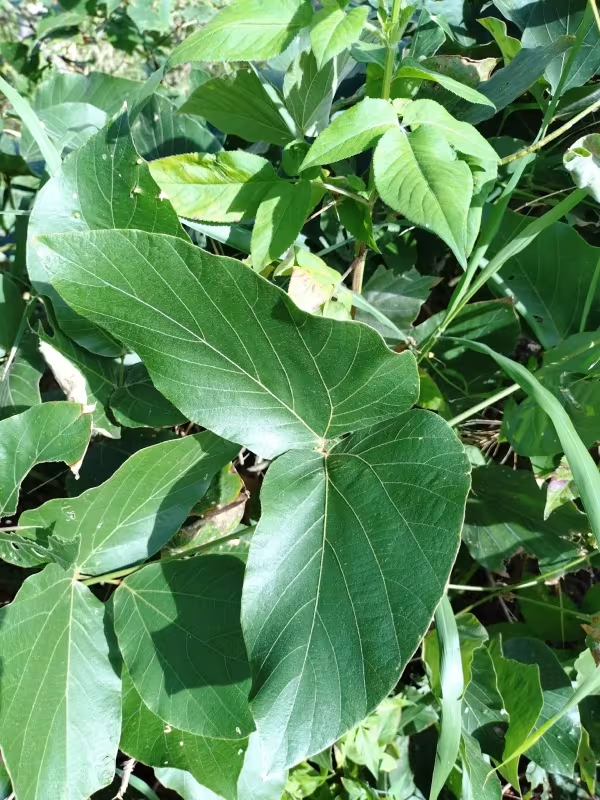
Description
Sowing dates
Sowing of Pueraria montana should be scheduled for the spring season once soil temperatures consistently reach 15–18 degrees Celsius.
Since the seeds possess a hard seed coat, pre-sowing scarification is highly recommended to significantly improve germination rates and uniformity.
The seeds should be planted at a depth of approximately 2–3 centimeters to ensure optimal moisture uptake and proper root development.
Spacing requirements involve maintaining row widths of 60 to 90 centimeters, allowing sufficient room for the plant's aggressive climbing nature.
In regions with shorter growing seasons, starting the plants in greenhouses and transplanting them after the last frost is a common practice.
Growing requirements
As a vigorous member of the Fabaceae family, Pueraria montana thrives in warm climates and requires abundant sunlight for maximum vegetative growth.
The plant prefers well-drained loamy or sandy soils and is sensitive to waterlogged conditions which can lead to root system degradation.
It exhibits remarkable drought tolerance due to its deep taproot system, which accesses water supplies inaccessible to many other crops.
The optimal temperature range for rapid development is between 20 and 30 degrees Celsius, facilitating the characteristic rapid expansion of vines.
While the plant can survive in various soil types, providing physical support structures or trellises enhances yield if production targets include pods.
Yield
The biomass yield of Pueraria montana is exceptional, often producing massive amounts of forage material throughout the growing season.
Regular harvesting allows for multiple cuttings, providing a highly nutritious source of protein for livestock feed in the form of hay or silage.
The starchy roots are another vital economic product, utilized in industrial manufacturing and for the extraction of high-quality plant starches.
Yield stability is maintained by the plant's natural ability to fix atmospheric nitrogen, reducing the need for intensive nitrogen-based fertilization.
Economic efficiency depends on effective site management and the use of mechanical harvesters capable of dealing with thick, intertwined vines.
Main diseases and pests
Common agricultural threats include various foliar diseases such as leaf spots and anthracnose, which are exacerbated by high humidity levels.
Pests like spider mites and certain defoliating insects can significantly impact plant health, particularly in young or stressed plantations.
Effective weed control during the establishment phase is critical, although the plant itself can become invasive if not properly contained.
Integrated pest management strategies should be employed to reduce chemical usage, especially when cultivation serves pharmaceutical purposes.
Ensuring adequate air circulation through proper planting density and regular monitoring is essential to prevent the spread of fungal infections.
Harvesting
Harvesting for forage should occur during the flowering stage, ensuring the nutritional density of proteins and minerals is at its peak level.
Root harvesting is generally performed at the end of the growth cycle when the above-ground biomass begins to senesce and die back naturally.
Post-harvest processing involves rapid drying or mechanical chopping to preserve quality and prevent spoilage or fermentation of the harvested biomass.
If the plantation is intended for long-term use, the harvest method must be selective to ensure the base and root structures remain undisturbed.
Organic residue from the harvesting process acts as a green manure, contributing positively to the overall soil health and fertility of the field.