
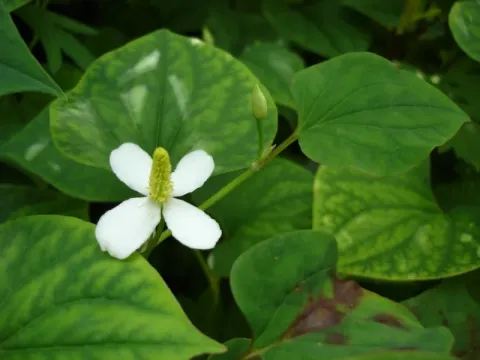
Houttuynia cordata
Houttuynia Thunb. corr. Thunb.
Houttuynia cordata is primarily propagated through vegetative methods, specifically by dividing rhizomes or taking cuttings during the spring season.
What the section contains

Houttuynia cordata
Division of the rhizomes is best performed early in the spring as the plant emerges from dormancy, ensuring rapid establishment in the new location.
Stem cuttings can be taken during the first half of summer; they root readily in a consistently moist growing medium under moderate temperatures.
Seed propagation is possible but less common; seeds should be sown in late winter in a greenhouse environment to maintain the required high humidity.
Given the plant's invasive potential due to its rapid rhizome growth, it is crucial to plant it in contained areas or areas with natural barriers.
Houttuynia cordata is a moisture-loving perennial herb belonging to the Saururaceae family, native to East and Southeast Asia.
The plant thrives in partial shade or full sun, provided that the soil moisture levels are consistently high throughout the growing season.
It prefers rich, loamy soils with a neutral or slightly acidic pH, and it is exceptionally well-suited for wet sites or shallow water edges.
As a highly water-dependent species, irrigation is essential in drier climates to prevent the foliage from wilting and to sustain biomass production.
In regions with harsh winters, winter protection such as mulching is recommended to safeguard the underground rhizomes from freezing temperatures.
The economic value of Houttuynia lies in its aerial parts, which are harvested for both culinary garnishes and as a significant component in traditional herbal medicine.
Yield is primarily determined by the availability of water and the density of planting, as the crop naturally forms dense, lush ground cover mats.
Commercial production allows for multiple harvests throughout the growing season, provided that the plant is managed in nutrient-rich conditions.
The crop is highly valued for its unique flavor profile, described as fishy or coriander-like, catering to specific ethnic and culinary market segments.
Application of nitrogen-based fertilizers during the peak growing phase significantly improves both the overall yield and the quality of the harvested green mass.
The plant is remarkably hardy and exhibits natural resistance to most common garden pathogens, significantly reducing the need for chemical pesticides.
Excessive soil saturation during freezing weather poses the greatest risk, as it may lead to root rot if drainage is completely absent.
Pests are rarely an issue for Houttuynia, largely due to the presence of potent volatile oils that act as natural deterrents against many insect species.
In highly shaded and damp environments, slugs may occasionally feed on the tender young foliage, requiring basic manual management.
Good agricultural practices, such as ensuring proper plant spacing and avoiding water stagnation, are sufficient to prevent most common threats.
Harvesting involves cutting the fresh, young stems and leaves, which are at their peak aroma and medicinal potency before the flowering stage.
Precision tools should be used for harvesting to ensure clean cuts, which aids in the rapid recovery and secondary growth of the plant.
Freshly harvested material is highly perishable and should be processed or refrigerated immediately to maintain its volatile oil content and flavor.
When intended for drying, the plant material must be kept in cool, shaded, and well-ventilated conditions to prevent the degradation of active chemical compounds.
Effective post-harvest management is vital to maintaining the high market value of this herb, particularly for specialty culinary and pharmaceutical exports.