
Girardinia palmata
Girardinia palmata
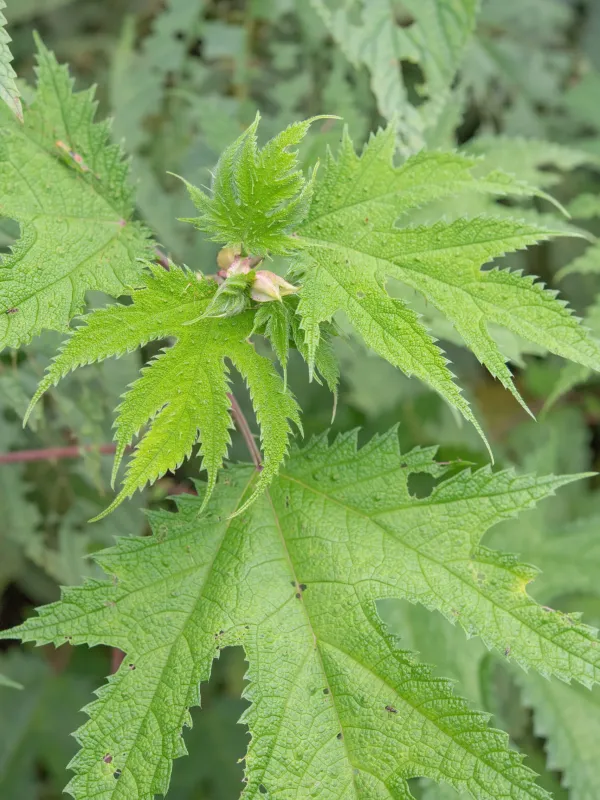
Description
Growing requirements
Girardinia palmata, commonly known as Himalayan nettle, is a perennial herbaceous plant belonging to the Urticaceae family. It is native to the temperate and subtropical regions of the Himalayas, thriving in shaded, humid environments.
The plant requires fertile, well-draining soils with high organic content to achieve optimal growth. It is typically found at altitudes ranging from 1,200 to 3,000 meters, where it benefits from high atmospheric humidity and seasonal rainfall.
Cultivation practices involve selecting shaded or semi-shaded areas to mimic its natural forest habitat. The plant is relatively resilient but requires consistent moisture during its active growing season to prevent stunted development.
Botanically, Girardinia palmata is distinguished by its large, palmate leaves and dense clusters of stinging hairs. Its stems are robust and fibrous, capable of reaching heights of up to 3 meters, which makes them ideal for industrial fiber extraction.
Due to its ecological adaptability, it is an excellent candidate for agroforestry systems. It provides environmental benefits by preventing soil erosion on mountain slopes while yielding valuable raw materials for local industries.
Harvesting
Harvesting is traditionally performed manually before the plant enters the full flowering stage to ensure the highest quality of the bast fibers. Workers must exercise caution due to the presence of potent stinging hairs covering the stems.
The extracted fibers are processed through retting, washing, and drying. This natural fiber is highly valued in the textile industry for its exceptional tensile strength, lightweight nature, and resistance to environmental decay.
Beyond textile production, the fiber is used for manufacturing ropes, fishing nets, and high-quality paper. These products are increasingly sought after in sustainable fashion and eco-friendly manufacturing sectors.
Sustainable harvesting techniques ensure the regeneration of the plant population. By harvesting only the mature stems, farmers maintain the health of the perennial root system, allowing for consistent yields over several years.
- Requires moisture-rich growing sites.
- Manual harvesting for fiber extraction.
- Excellent tensile strength of the fiber.
- Eco-friendly agricultural alternative.
- Long-term harvest potential per plant.