
Dieffenbachia hybrid
Dieffenbachia hybrids
Description
Growing requirements
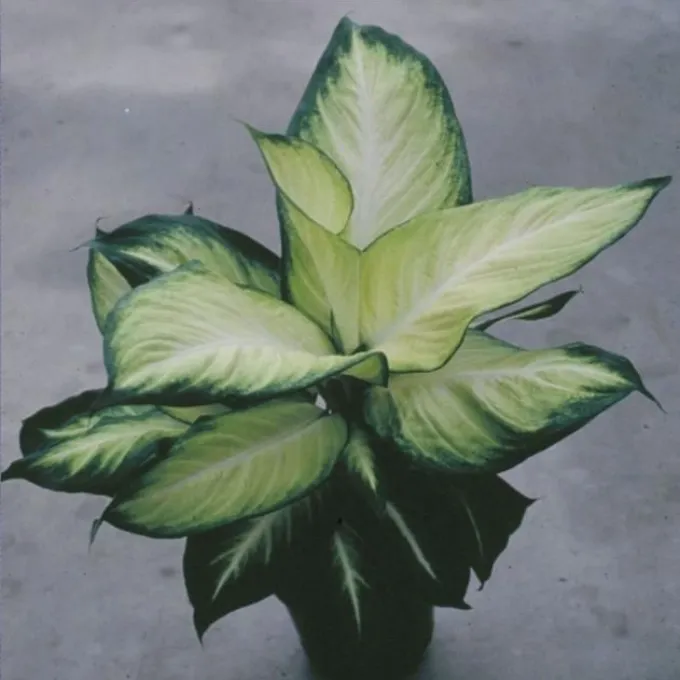
Dieffenbachia hybrid (Dieffenbachia hybrids) is a popular indoor ornamental plant belonging to the Araceae family. Its origins are rooted in the tropical rainforests of the Americas, where it thrives in warm and humid understory conditions.
The culture requires a stable environment with temperatures between 20 and 25 degrees Celsius. It is highly sensitive to sudden temperature fluctuations and cold drafts, which can cause significant physiological stress and leaf drop.
For optimal growth, the substrate must be well-drained, porous, and nutrient-rich. An ideal potting mix should consist of peat, perlite, and bark to ensure sufficient aeration for the sensitive root system.
Lighting should be bright but filtered. While these hybrids are known for their shade tolerance, excessive darkness results in etiolation, while excessive direct sun exposure causes severe leaf tissue burns on the variegated foliage.
Watering requirements are consistent: the medium should be kept moist but never waterlogged. High ambient humidity is crucial, requiring regular misting or the use of humidifiers in environments with low air moisture levels.
Main diseases and pests
Spider mites are the most common pests, particularly prevalent in low-humidity environments. They cause stippling and webbing on the leaves, which significantly reduces the photosynthetic capacity of the plant.
Mealybugs and scale insects also pose a threat by colonizing leaf axils and the undersides of foliage, feeding on sap and excreting honeydew that fosters sooty mold growth.
Fungal diseases, primarily root rots caused by Phytophthora or Pythium species, are the direct consequence of overwatering and inadequate drainage systems in the pots.
Bacterial leaf spot can be identified by water-soaked lesions that may spread rapidly. Management requires strict sanitation, removing infected foliage, and avoiding overhead watering to keep leaf surfaces dry.
Operators must exercise caution, as all parts of the plant contain calcium oxalate crystals. These compounds can cause severe irritation and swelling upon contact with skin or mucous membranes during pruning or propagation.