
Dictyosphaerium
Dictyosphaerium
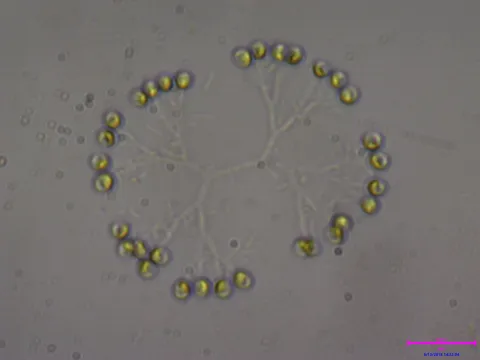
Dictyosphaerium is a genus of green algae belonging to the Dictyosphaeriaceae family. These are microscopic planktonic organisms characterized by spherical or ellipsoidal cells that are typically held together in colonies by mucilaginous strands.
What the section contains

Dictyosphaerium
Optimal growth of the culture requires high light intensity, as Dictyosphaerium relies entirely on photosynthesis. A temperature range between 20 and 25 degrees Celsius is considered ideal for maintaining metabolic stability and ensuring steady biomass accumulation.
The nutrient medium must provide a balanced supply of nitrogen, phosphorus, and silicon to support cell wall formation and protein synthesis. A slightly alkaline pH, between 7.0 and 8.5, is necessary to prevent nutrient precipitation and promote optimal uptake.
In commercial cultivation, photobioreactors are utilized to ensure proper gas exchange and light distribution. Continuous carbon dioxide injection is essential for maximizing growth rates in high-density indoor production systems.
Botanically, the ability to form colonies is an evolutionary adaptation that helps these algae maintain buoyancy in aquatic environments. Understanding this structure is crucial for effective harvesting and processing in industrial setups.
The yield of Dictyosphaerium is primarily determined by light saturation levels and nutrient availability within the bioreactor. High productivity is achieved through continuous monitoring and adjustment of culture conditions to sustain exponential growth phases.
This microalga is increasingly used in aquaculture as a nutritional feed additive. Its biomass is rich in essential amino acids and lipids, which are vital for the development and health of juvenile aquatic species and shrimp larvae.
Environmental monitoring is another application, where Dictyosphaerium serves as a bioindicator of water quality. Its presence and growth density can provide data on the trophic state and organic nutrient levels of natural or man-made aquatic ecosystems.
Harvesting involves mechanical methods such as centrifugation or membrane filtration to concentrate the cells. The resulting slurry is often freeze-dried or spray-dried to preserve its nutritional integrity for subsequent use as fish meal supplements.
Selective breeding and strain improvement programs aim to increase the lipid content and growth rate of the culture. These efforts significantly enhance the economic viability of Dictyosphaerium production in the biotechnological sector.
The primary threats to Dictyosphaerium cultures include pathogenic fungi and protozoan predators. If not strictly controlled, these organisms can quickly dominate the bioreactor environment, causing mass mortality of the algal colonies.
Viral infections pose a significant risk to pure cultures, often leading to rapid cellular lysis. To mitigate this risk, operators typically use advanced UV-sterilization and filtration systems for both water and air inlets.
Competition from fast-growing, non-target algal species can compromise the purity and yield of the harvest. Implementing routine cleaning cycles and maintaining optimized growth conditions are critical strategies to outcompete invasive species.
Chemical stress caused by heavy metal accumulation or pH fluctuations can inhibit growth and lead to culture decline. Regular testing of the nutrient medium is essential to ensure that toxic substances do not reach concentrations that impair algal health.
Thermal stress from overheating represents a physical threat to the delicate cell structure of Dictyosphaerium. Precise climate control and automated cooling systems are necessary to prevent heat-induced damage to the photosynthetic apparatus.