
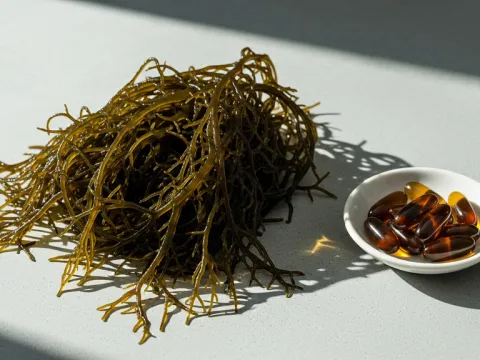
Cladosiphon
Cladosiphon
Cladosiphon, widely known as Mozuku, is a genus of brown algae belonging to the Chordariaceae family. Unlike land crops, its lifecycle involves controlled seeding of substrates within specialized marine nurseries.
What the section contains

Cladosiphon
Reproduction begins with the release of zoospores, which attach themselves to artificial threads or nets. In aquaculture, this stage is strictly regulated and conducted during the autumn-winter season to ensure optimal survival rates.
The preparation of seeding material takes place in controlled tanks where water is saturated with spores. This stage requires sterile conditions and precise temperature management to guarantee a high density of spore attachment.
Once sufficient growth is achieved on the nets, they are transferred to open sea plantations. This process is similar to transplanting seedlings, where the secure anchoring of structures on the seafloor is of paramount importance.
The timing of the transfer depends on marine current temperatures, usually occurring in late autumn. Correct scheduling prevents competition with other epiphytic algae species.
This crop has high requirements for seawater quality, preferring areas with moderate currents and high nutrient content. The optimal water temperature for active growth ranges between 15 and 25 degrees Celsius.
The algae require good light exposure, so plantations are positioned in shallow waters where sunlight penetrates to a depth of 2 to 5 meters. This ensures an adequate level of photosynthesis for biomass accumulation.
A critical factor is water salinity, which must remain stable throughout the growing season. Significant freshening due to heavy rainfall can negatively impact the development of the thalli.
The cultivation substrate must be clean and free from silt deposits. Modern farms utilize nylon nets that are easily cleaned and provide excellent adhesion for the young plants.
An important maintenance aspect is the removal of competing seaweed species and marine organisms that might restrict the access of nutrients to the Cladosiphon thalli.
Cladosiphon yield depends on planting density and the quality of care during the active growth phase. Industrial plantations provide stable output when cultivation technologies are properly followed.
The average biomass weight per linear meter of supporting rope can reach several kilograms under favorable conditions. Harvesting is conducted once per season when the algae reach maximum size.
Commercial utilization focuses on extracting fucoidan, a valuable polysaccharide with significant biological properties. Beyond pharmacology, it is widely used in the food industry.
The high value of the product makes intensive farming on small sea plots economically viable. Standardization of harvesting processes preserves the product's appearance and natural properties.
Economic efficiency is directly correlated with the logistics of transporting raw material to processing facilities, where primary handling and preservation occur.
The main threats to plantations include fungal and bacterial infections that lead to thallus decay. Rapid fluctuations in water temperature can weaken the culture's immune system.
Typical pests include sea urchins and certain types of mollusks that graze on young seaweed shoots. Damage to the thalli by these organisms leads to a decline in crop quality.
Pollution from industrial or municipal runoff is a critical risk causing massive crop failure. Environmental monitoring of the sea area is mandatory to prevent damage.
Negative impact is also caused by epiphytic algae that block light access. Regular cleaning of the plantations is a necessary agricultural practice.
Storm activity in the coastal zone can mechanically damage structures, leading to the breaking of nets and the loss of a significant portion of biomass before harvest.
Harvesting begins in spring when rising water temperatures stimulate rapid growth. The process is mechanized and requires specialized equipment for lifting the nets.
The collected seaweed undergoes primary cleaning to remove impurities, sand, and small marine organisms. This is essential for maintaining product quality prior to drying or freezing.
Storage methods include flash freezing or salting, which allows the preservation of fucoidan properties for an extended period. Quality is monitored at every stage of processing.
After the harvest, plantations are cleared of all biomass residues, and all structural elements are disinfected. This prevents the accumulation of pathogens for the next season.
Successful harvesting requires coordinated team efforts and powerful pumping systems for initial washing of the raw material directly on board the support vessels.