
Capillipedium assimile
Capillipedium assimile
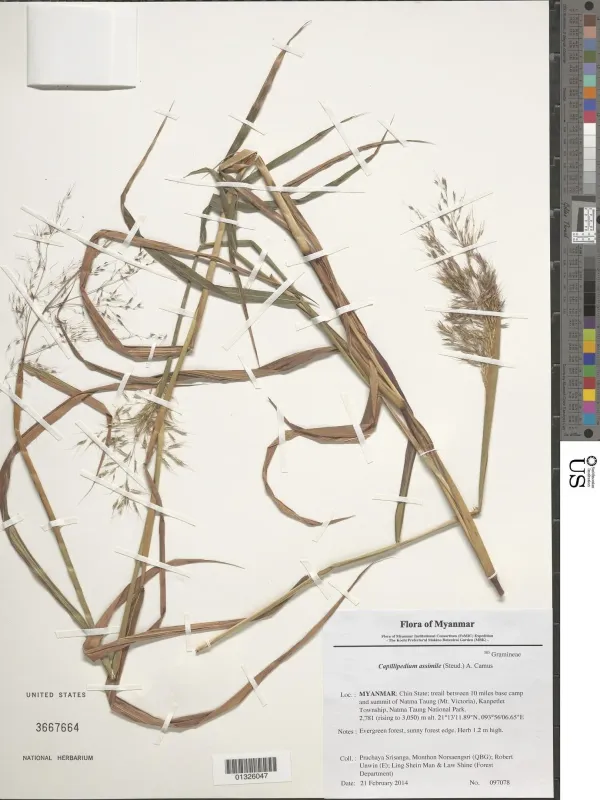
Description
Sowing dates
Capillipedium assimile is a perennial grass species typically propagated through seeds in agricultural settings. Sowing is best initiated during the spring months once soil temperatures reliably reach 15–18 degrees Celsius, ensuring optimal germination rates and vigorous early establishment.
Maintaining the correct seeding rate is essential for developing a productive stand. Given that the seeds are quite small, a shallow seeding depth of approximately 1 to 2 centimeters is required to avoid exhausting the seed's energy reserves before emergence.
Modern precision planting equipment is recommended to achieve uniform seed distribution. Post-sowing, field rolling is a critical step as it ensures firm soil-to-seed contact, which significantly improves water uptake and accelerates the germination process.
Preparation of the seedbed should involve effective weed management, as Capillipedium assimile exhibits a relatively slow growth rate during the seedling stage. Eliminating competition from aggressive weeds is vital for the grass to establish a robust root system in its first year.
The choice of planting location should account for local climatic conditions to avoid periods of extreme drought or late spring frosts that might impede early development. Planning around the rainy season is often the most successful strategy for large-scale establishment.
Growing requirements
Belonging to the Poaceae family, this plant is known for its ecological plasticity within its native range. It thrives in well-drained, sunny locations and is generally sensitive to waterlogged or overly compacted soils, which can lead to root asphyxiation.
Capillipedium assimile prefers soils with a neutral to slightly acidic pH, ranging from sandy loams to heavier silt loams. Good soil aeration is paramount, as the species requires a balance of moisture and oxygen to support its complex root structures effectively.
Temperature stability during the growing season is crucial for maximizing biomass production. While the species demonstrates a degree of drought tolerance, consistent moisture—whether through rainfall or supplementary irrigation—is necessary to unlock its full potential.
Light exposure is a significant factor in photosynthesis and development; therefore, open sites are preferred over shaded or wooded areas. Adequate sunlight is required to maintain the structural integrity of the stems and the nutritional quality of the foliage.
Fertilization programs, particularly those focusing on nitrogen application during the tillering phase, can significantly boost yield. Monitoring the balance of micronutrients in the soil is also important to maintain the plant's resistance to environmental stress.
Yield
The yield of Capillipedium assimile is influenced by the intensity of management practices, including irrigation and fertilization. Under ideal conditions, this grass can produce multiple cuts per season, providing a steady supply of high-quality forage.
Peak biomass production usually occurs between the second and fifth year of the stand's life. During this period, the plant's root system is fully mature, allowing it to efficiently extract nutrients and water to sustain high leaf area indices.
Implementing intensive management, such as controlled irrigation, can nearly double the seasonal output of dry matter compared to non-irrigated fields. This makes it an attractive choice for farms with robust water management infrastructure.
Variations in yield may occur based on local topography and soil health. Regular agronomic monitoring helps in adjusting management strategies, such as the timing and frequency of cuts, to ensure maximum economic return from the land.
Seed production serves as an additional revenue stream. By managing specific sections of the field for seed harvest rather than forage, farmers can generate a high-quality seed bank, reducing reliance on external inputs for field expansion.
Main diseases and pests
Like many grasses in the Poaceae family, Capillipedium assimile is susceptible to various rust pathogens. These fungi primarily affect the leaf surfaces, leading to reduced photosynthetic capacity and diminished nutritional value of the harvested biomass.
Powdery mildew may also emerge as a threat in conditions with high humidity and poor air circulation within the stand. Proper field spacing and density management are effective preventative measures against the rapid spread of such infections.
Insects such as cereal aphids and specific weevils can cause significant damage to both the vegetative shoots and the reproductive organs of the grass. Monitoring for pest thresholds is critical before deciding on any chemical intervention.
Integrated Pest Management (IPM) practices, including the use of resistant varieties and crop rotation, are the best defense against long-term pest pressure. Avoiding monoculture dominance can help break the cycle of infection and infestation.
Sanitation practices, such as removing crop residues at the end of the season, are essential to minimize the overwintering potential of harmful pathogens and pests, thereby providing a cleaner start for the subsequent growing year.
Harvesting
Harvesting for forage is recommended during the early flowering or heading stage. At this phenological phase, the ratio of proteins to structural fibers is optimal, ensuring the grass is highly digestible and nutrient-dense for livestock.
Rapid field drying is essential for producing high-quality hay. The use of tedders to turn the forage ensures uniform moisture reduction, which prevents spoilage and mold growth during the drying process and preserves the integrity of the leaves.
Seed harvesting requires careful timing to avoid shatter losses. Collection should occur when the grains have reached physiological maturity, characterized by a firm texture and low moisture content, but before they detach naturally from the florets.
Post-harvest conditioning involves cleaning the seed lots of debris and ensuring moisture levels meet storage standards. Proper storage in cool, dry environments is necessary to maintain high seed viability for the following planting season.
After the final cut, managing the remaining stubble is important for the plant's longevity. Leaving an appropriate height or light mulching can encourage healthy regrowth and provide better insulation for the roots during colder periods.