
Bucephalandra gigantea
Bucephalandra gigantea
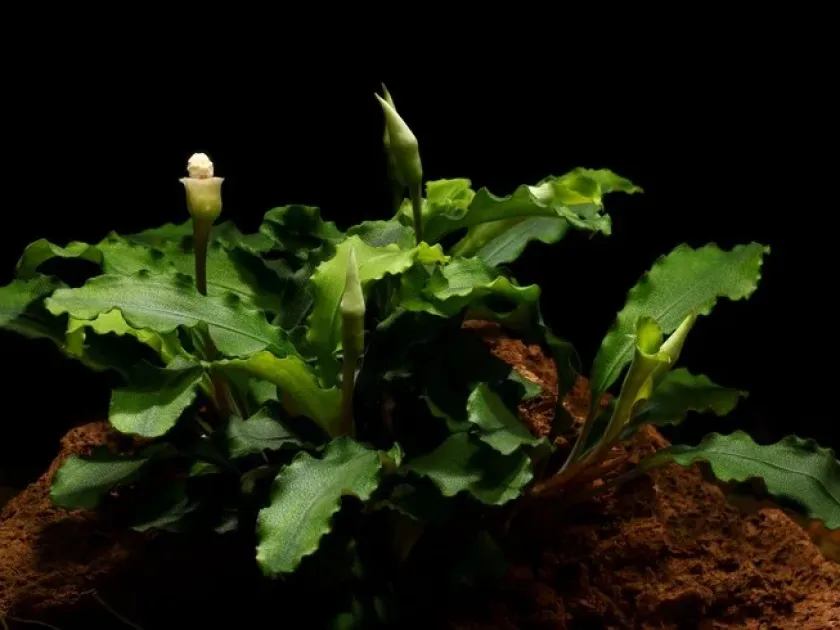
Description
Growing requirements
Bucephalandra gigantea is a fascinating member of the Araceae family, native to the tropical rainforests of Borneo. It is an amphibious plant that naturally thrives in fast-flowing streams, adhering to rocks and submerged logs.
Botanically, it is classified as a rheophyte, a plant adapted to environments with strong water currents. Its morphology includes a creeping rhizome and thick, leathery leaves which provide stability against water flow.
For successful agricultural cultivation in aquatic systems, the plant requires clean, oxygen-rich water. While it can adapt to various conditions, maintaining a temperature between 22 and 26 degrees Celsius is critical for optimal growth.
Although it does not require a traditional soil substrate, the plant benefits from micronutrient supplementation within the water column. CO2 fertilization is highly recommended to encourage faster growth and vibrant leaf coloration.
Propagation is primarily achieved by pruning the rhizome. Each fragment must contain a portion of the stem and several healthy leaves to ensure continued vitality and successful establishment in a new environment.
Main diseases and pests
The most significant challenge for Bucephalandra gigantea is the development of biofilm and filamentous algae on the leaf surface. These organisms compete for light and nutrients, significantly weakening the plant.
The phenomenon known as rhizome rot is often triggered by poor water circulation or the accumulation of anaerobic detritus near the root zone, leading to rapid tissue death.
Adaptation stress is another major threat; when moved to new water parameters, the plant may experience a rapid shedding of leaves, often referred to by hobbyists as a melting event.
Nutrient imbalances, particularly regarding iron and magnesium deficiency, can lead to chlorosis, where the leaves lose their deep green pigmentation and begin to exhibit yellowing patterns.
To mitigate these risks, maintaining a rigorous water change schedule and ensuring stable chemical parameters is essential for the long-term health and productivity of this crop.