
Saharan mustard
Brassica tournefortii Gouan
Description
Growing requirements
Saharan mustard (Brassica tournefortii) is an annual herb belonging to the Brassicaceae family. While it is related to cultivated cruciferous crops, it is widely recognized as a highly invasive and problematic weed in agricultural systems worldwide.
Native to the arid regions of North Africa, the Middle East, and Mediterranean Europe, it has successfully colonized vast desert areas. It is particularly notorious in regions like the Southwestern United States and Western Australia.
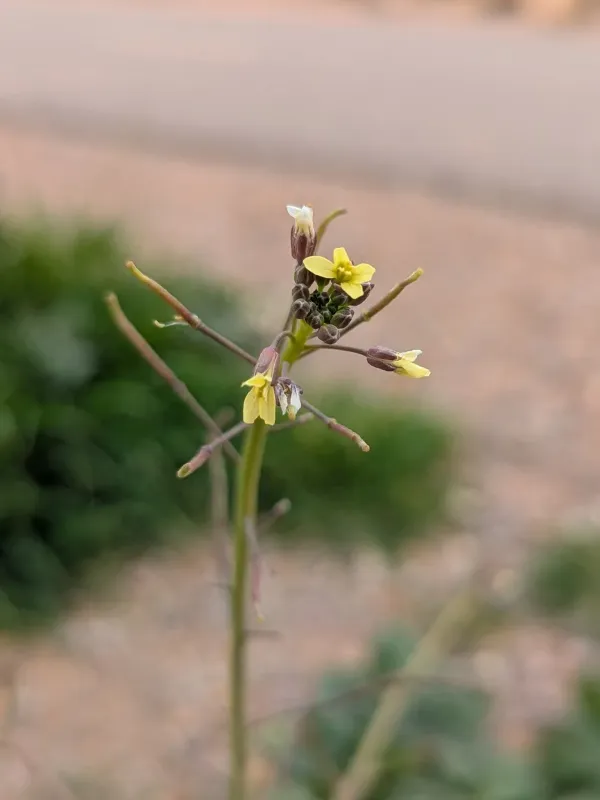
Botanically, it is characterized by a basal rosette of deeply lobed leaves and small, pale-yellow flowers. The stems are typically covered with coarse, stiff hairs at the base, and it produces numerous small seeds in elongated siliques.
The plant thrives in sandy or light-textured soils and is remarkably adapted to drought conditions. It can complete its life cycle rapidly, often germinating after early autumn or winter rains, long before other desert vegetation begins to grow.
There is no standard commercial cultivation for this species. Its presence in agricultural fields is largely negative, as it outcompetes crops for soil moisture and nitrogen, significantly reducing yields in arid or semi-arid farming environments.
Main diseases and pests
Common pests include crucifer-specialized insects such as the diamondback moth, cabbage aphids, and flea beetles. The plant serves as a host, allowing these pests to survive in fields where main crops are not currently growing.
Diseases affecting this species include downy mildew, white rot, and various types of black rot. Because it shares pathogens with crops like canola, mustard, and cabbage, its presence poses a risk of spreading diseases to commercial fields.
Managing this weed is extremely challenging due to its high seed production. A single plant can produce thousands of seeds that remain viable in the soil for several years, creating a long-term weed seed bank that is difficult to exhaust.
Manual control is only effective in the early vegetative stage. Once the plant enters the bolting phase, its deep taproot makes mechanical removal labor-intensive, and even cut plants can sometimes continue to ripen their seeds.
Chemical control focuses on applying selective herbicides during the rosette phase. Integrated pest management strategies, such as crop rotation and early field scouting, are essential to minimize the impact of this invasive species on crops.