
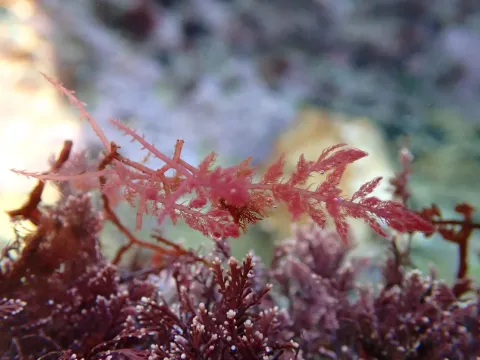
Asparagopsis
Asparagopsis Montagne
Asparagopsis is a genus of red algae belonging to the Bonnemaisoniaceae family, characterized by a complex heteromorphic life cycle. It is a highly valued marine organism that has gained significant interest in global agriculture due to its unique chemical properties.
What the section contains

Asparagopsis
The cultivation process begins with the propagation of gametophytes or tetrasporophytes in controlled aquaculture facilities. These stages require precise environmental monitoring to ensure that the biomass develops at an optimal rate, free from contamination.
In industrial mariculture, the algae are attached to ropes or nets, which serve as the primary substrate for growth. This method maximizes surface area exposure to nutrient-rich water, which is essential for the rapid accumulation of desired secondary metabolites.
Biologically, Asparagopsis is highly adaptive, yet it remains sensitive to the flow of water and nutrient concentrations. Maintaining a consistent hydraulic regime is vital for providing the necessary minerals to sustain the intensive growth of the thallus.
The scalability of farming this culture is currently being researched, with trials focusing on land-based integrated systems. These systems allow for a high degree of control over the growth environment, leading to consistent yields throughout the year.
The temperature requirements for Asparagopsis range from 15 to 25 degrees Celsius, depending on the species; for instance, Asparagopsis taxiformis thrives in warmer, tropical, and subtropical maritime environments.
Light intensity is a critical factor for photosynthesis, as the algae require a specific spectrum to drive the chemical production of halogenated compounds. In indoor cultivation, artificial lighting is calibrated to simulate the necessary solar irradiance.
Water quality must be pristine, with stable levels of nitrogen, phosphorus, and trace minerals. Excessive turbidity or chemical pollution can inhibit growth and lead to the degradation of the bio-active molecules that make this crop commercially valuable.
Salinity levels must be kept within the normal oceanic range to prevent osmotic stress. Frequent monitoring of the growth medium is necessary to adjust nutrient dosages and ensure that the algae remain in an optimal metabolic state.
Proper water circulation prevents the stagnation of nutrients and the buildup of waste products. In oceanic farms, selecting sites with stable, moderate currents is key to ensuring the health and productivity of the crop throughout its cycle.
The yield of Asparagopsis is dependent on the stocking density and the frequency of the harvest cycles. Intensive farming techniques allow for significantly faster growth rates compared to wild populations, resulting in a more sustainable harvest.
Its primary commercial application lies in the livestock feed industry, where it is used as a potent additive to significantly reduce enteric methane emissions in ruminants. This functionality has driven high demand for large-scale production.
Profitability is largely determined by the bromoform content in the harvested biomass. Scientific efforts are currently focused on selecting high-yield strains and optimizing nutrient delivery to maximize the concentration of these essential compounds.
Effective management allows for multiple harvests from the same substrate, as the algae can regenerate rapidly if a portion of the thallus is left behind. This regeneration capacity significantly reduces operational costs.
Post-harvest processing is a critical component of the yield equation. Proper handling, including low-temperature drying and stable storage, ensures that the bromoform content remains active until the final product reaches the end-user.
The most significant threat to seaweed farms is the proliferation of epiphytic microalgae. These competitors can cover the surface of the main crop, effectively blocking the light and nutrients required for healthy growth.
High water temperatures can trigger bacterial infections or fungal outbreaks, which may cause rapid necrosis of the tissues. Maintaining optimal temperatures and good hygiene protocols is the first line of defense against these biological threats.
Marine pests, such as amphipods and various mollusks, can cause mechanical damage by grazing on the tender parts of the plant. Using protective mesh enclosures is a common and effective strategy to mitigate such losses.
Pollution from heavy metals or industrial runoff represents a severe risk to the safety of the product. Strict adherence to water quality guidelines is essential to prevent the accumulation of toxins in the biomass intended for animal feed.
Climate change poses a long-term threat to traditional maritime farming due to ocean acidification and the unpredictable frequency of extreme weather events. Future-proofing farms requires the development of resilient, climate-adapted varieties.
Harvesting is usually scheduled based on the metabolic maturity of the algae to ensure the highest concentration of bio-active compounds. Mechanical cutters or specialized water-suction systems are used to collect the biomass efficiently.
Post-harvest, the product undergoes immediate washing in seawater to remove impurities and sediment. Quick processing is mandatory to preserve the volatile components that are sensitive to degradation.
Low-temperature drying techniques are essential to preserve the chemical integrity of the seaweed. The goal is to remove moisture without causing the thermal breakdown of the heat-sensitive compounds responsible for methane reduction.
Storage requires air-tight, moisture-proof, and light-protected packaging to maintain product quality during transport. Any exposure to the environment before use can lead to the loss of its efficacy as a feed additive.
Systematic harvesting ensures a continuous production cycle, allowing producers to meet the rising global demand. Investing in advanced harvest technology is fundamental to making Asparagopsis a staple in sustainable agricultural practices.