
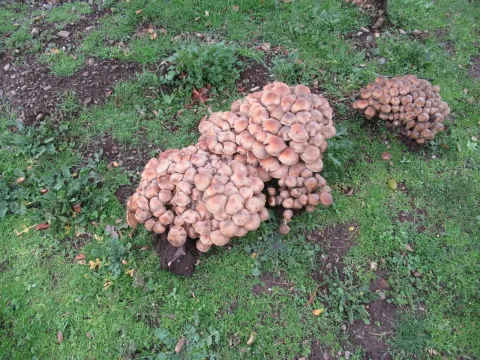
Honey fungus
Armillaria (Fr.) Staude
The cultivation of Honey fungus (Armillaria) starts with selecting high-quality spawn, typically applied to wooden logs or sterilized sawdust-based substrates.
What the section contains

Honey fungus
Inoculation of logs is best performed in early spring as soon as the frost risk has passed, allowing the mycelium to establish before the heat of summer.
For log cultivation, holes are drilled into the wood, filled with spawn, and sealed with wax to maintain internal moisture and prevent contamination by airborne spores.
Industrial cultivation on sawdust blocks requires sterile laboratory conditions to ensure that the mycelium outcompetes common molds during the incubation phase.
The success of the sowing phase depends heavily on the moisture content of the substrate, which must be carefully balanced to facilitate rapid mycelial colonization.
Honey fungus belongs to the Physalacriaceae family and is naturally known as a wood-decaying saprotroph or parasite, depending on the environment.
The growth phase requires a stable temperature of 20–25 degrees Celsius, while the fruiting phase requires a drop in temperature to 10–15 degrees Celsius.
Humidity is paramount; a relative humidity of 80–90% is needed to prevent the drying of young primordia, which are extremely sensitive to environmental stress.
Good ventilation is necessary to control the levels of carbon dioxide, which can cause abnormal elongation of the mushroom stalks if levels are too high.
The ideal substrate includes hardwood logs or wood chips, such as oak, birch, or poplar, as these provide the necessary nutrients for dense mushroom formation.
With optimized indoor cultivation, yields can reach 25% of the total substrate weight over the entire cropping period, usually spanning several weeks.
When grown on outdoor logs, the yield is lower but sustained over several years, as the mycelium slowly breaks down the hardwood structure.
The first crop, or flush, usually provides the largest quantity of mushrooms, with subsequent flushes being smaller but often of higher individual quality.
Monitoring the rate of decay in the wood provides a clear indicator of the potential yield remaining before the substrate becomes exhausted.
Proper environmental management, particularly light and moisture control, is the primary lever for maximizing the biological efficiency of the crop.
Contamination by aggressive mold species like Trichoderma is the most significant threat to the indoor cultivation of Armillaria.
Insects, particularly sciarid flies, are attracted to the decaying wood and can damage the crop by feeding on the mycelium and developing mushrooms.
Bacterial spots on the mushroom caps often indicate poor air circulation or excessive water sitting on the fruit bodies for too long.
Because Armillaria is also a pathogen of living trees, strict containment is required to ensure that the cultivated strain does not infect surrounding vegetation.
- Rigorous hygiene in the growing room.
- Sterilization of the substrate before inoculation.
- Use of resistant strains and clean spawn.
Harvesting should occur when the veil under the cap is still intact, ensuring the mushrooms are firm and have not yet released their spores.
Mushrooms are harvested in clusters using a sharp knife to cut them at the base, keeping the surface of the log or block as clean as possible.
Post-harvest handling is critical; mushrooms should be chilled to 2–4 degrees Celsius to extend their shelf life and maintain their texture.
Any damaged or over-mature mushrooms must be removed immediately to prevent them from becoming a breeding ground for bacteria or mold.
Once the production cycle on a block is finished, the spent substrate should be composted away from the growing area to maintain sanitary conditions.