

Description
How to tell it apart
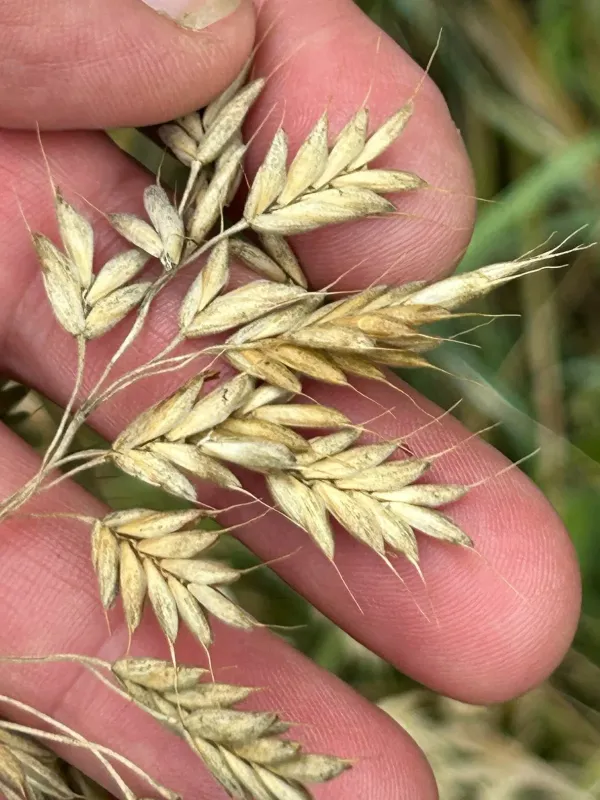
Bromus secalinus, commonly known as cheatgrass or rye brome, belongs to the Poaceae family. It is an annual grassy weed that closely mimics cereal crops, making it difficult to spot during early growth stages.
The plant grows stems ranging from 30 to 100 cm in height. Its leaves are linear and flat, often exhibiting characteristic hairiness, which helps in distinguishing it from smooth-leaved varieties.
The inflorescence is a loose or sometimes compressed panicle with nodding branches. Each panicle contains several large, oblong-ovate spikelets, each holding 6 to 10 individual florets.
The seeds (caryopses) of Bromus secalinus are similar in size and shape to wheat or rye grains, which makes mechanical cleaning and separation of infested grain extremely challenging.
It possesses a dense, fibrous root system that allows it to effectively extract water and nutrients from the soil, competing successfully with crops for limited resources.
Where it grows
This weed is most frequently found in winter cereal crops, particularly rye and wheat. It is a specialist weed that has evolved to match the lifecycle of winter-planted small grains.
Bromus secalinus thrives in fertile, clay-heavy, or loamy soils. It reproduces rapidly in fields where crop rotation is neglected and contaminated seed batches are repeatedly sown.
The plant has a wide distribution in temperate regions worldwide. It is highly adapted to overwintering, making it a persistent threat to winter wheat production across various climates.
It is also commonly found in disturbed areas such as field margins, roadsides, and abandoned lands, which serve as reservoirs for seeds that spread into cultivated fields via machinery.
Because of its adaptability, it can colonize various environments, though it shows a preference for nutrient-rich agricultural soils where crop competition is relatively low.
Harm it causes
The primary damage caused by cheatgrass is extreme competition for soil moisture, nutrients, and sunlight. By mirroring the development cycle of winter cereals, it suppresses crop yields significantly.
A high density of Bromus secalinus can cause crop lodging, as the weed shades the base of the cereal plants, leading to thinner stalks and reduced plant resilience to environmental stress.
The presence of its seeds in harvested grain reduces the overall market grade and quality. Farmers often face significant price discounts or expensive cleaning requirements at grain elevators.
Cheatgrass acts as a host for various cereal diseases, including rust and certain smut pathogens. This can increase the inoculum level in the field, leading to more frequent outbreaks of disease.
Furthermore, heavy infestations complicate harvest operations. The biomass of the weed increases the moisture content of the harvested grain and imposes mechanical stress on combines.
How to control
The most effective preventative measure is the use of high-quality, certified, and clean seed. Optical sorting technologies are essential for removing weed seeds that look like cereal grains.
Implementing a diverse crop rotation is a cornerstone of management. Rotating winter cereals with spring crops or broad-leaved crops helps break the lifecycle of the weed and reduces seed bank density.
Proper tillage, including deep plowing and timely stubble cultivation, can bury seeds at depths that inhibit successful germination, preventing them from emerging in the next crop cycle.
Chemical control involves the application of selective herbicides from the sulfonylurea group or other grassy-weed specific products registered for use in wheat or rye fields.
- Rigorous cleaning of harvesting machinery to prevent seed dispersal.
- Using competitive crop varieties to suppress weed growth.
- Applying herbicides at the correct phenological stage of the weed.
- Integrated pest management approach focusing on cultural practices.
Content graph
Connections · Cheatgrass
Most often together:
Marketplace
Products · 1
Biology
Taxonomy
- Latin name
- Bromus secalinus
- Family
- Однолетние злаковые