
Gnaphalium macounii
Gnaphalium macounii
Description
How to tell it apart
Gnaphalium macounii, commonly known as Macoun's cudweed, is an annual herbaceous plant belonging to the Asteraceae family. It is classified as an early spring annual weed.
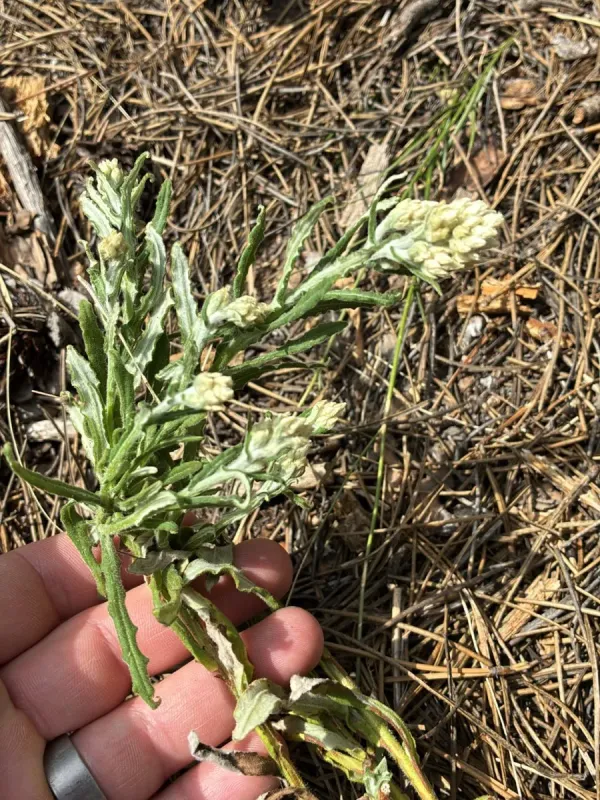
The plant features an erect stem that can grow between 30 and 90 centimeters in height. Its leaves are linear-lanceolate, deep green on top and densely covered with white, woolly hairs on the underside.
The inflorescences consist of numerous small flower heads arranged in dense corymbose clusters. The flowers are yellowish or brownish, surrounded by papery involucral bracts.
Reproduction occurs exclusively via seeds. Each fruit is a small achene equipped with a pappus, allowing for highly efficient wind dispersal across agricultural landscapes.
The root system is taprooted, enabling the plant to establish itself firmly in various soil types and survive periods of temporary drought by accessing deeper moisture layers.
Where it grows
This weed is typically found in disturbed areas, abandoned pastures, roadsides, and forest edges. It frequently invades agricultural fields, particularly in areas with sandy or light soil composition.
It prefers open, well-lit habitats where it can establish dominance quickly. It is highly adaptive to various moisture levels but thrives in regions where soil surface disturbance occurs.
In agricultural settings, it often appears as a ruderal species, colonizing the edges of crop fields and gradually spreading into the center of the plots.
The species is native to North America but has shown a strong ability to colonize similar habitats in other temperate regions due to its aggressive dispersal mechanism.
Its ability to grow in poor soil conditions makes it a persistent inhabitant of low-input fields and areas where standard tillage practices are occasionally overlooked.
Harm it causes
The primary harm caused by Gnaphalium macounii is the competition with young crops for essential resources such as sunlight, space, water, and soil nutrients during the early vegetative stage.
By consuming moisture and nutrients, the weed reduces the overall vigor of crops, often leading to reduced yields and uneven stand establishment in the field.
During the harvest process, the accumulation of weed biomass can lead to significant mechanical issues, including clogging of combine harvesters and increased crop moisture content.
It serves as an alternative host for various pests and fungal pathogens, potentially facilitating the spread of diseases to economically important agricultural crops.
Its prolific seed production ensures that even a few surviving plants can re-infest the field in the following season, creating a cycle of persistent weed pressure.
How to control
Effective agricultural control begins with deep primary tillage, such as moldboard plowing, which effectively buries seeds at depths that prevent successful germination.
Implementing a rigorous crop rotation strategy, particularly one involving row crops that require frequent mechanical inter-row cultivation, significantly suppresses the weed population.
Chemical control involving the application of selective post-emergence herbicides is most effective when applied early in the plant's development, ideally at the rosette stage.
Management of non-crop areas, including the mowing of field margins, fence lines, and roadsides before seed set, is critical to preventing the migration of seeds into the crop area.
- Deep soil cultivation
- Effective crop rotation
- Strategic herbicide application
- Regular field monitoring
- Sanitation of field edges
Taxonomy
- Latin name
- Gnaphalium macounii
- Family
- Прочие
- EPPO code
- GNAMA