
Amsinckia retrorsa
Amsinckia retrorsa
Description
How to tell it apart
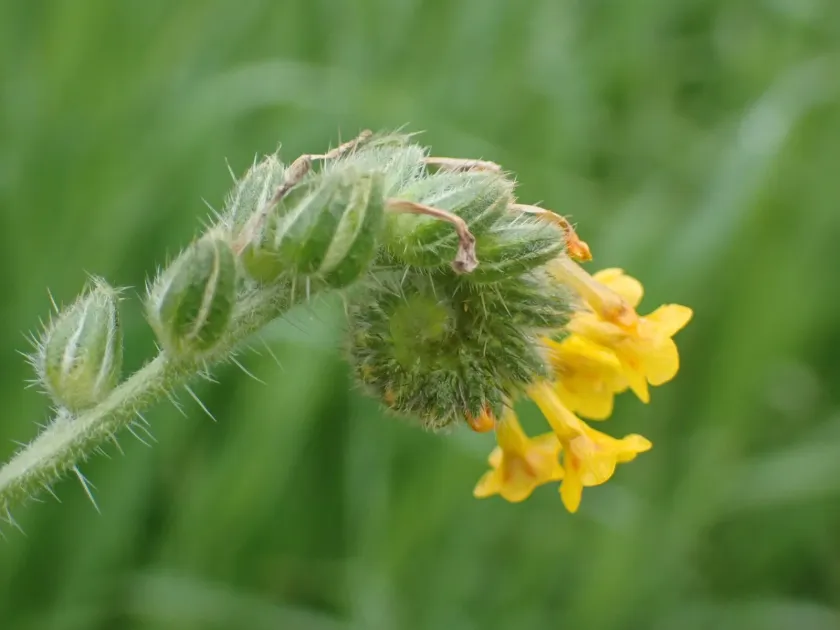
Amsinckia retrorsa, commonly known as a type of fiddleneck, belongs to the Boraginaceae family. It is an annual plant characterized by coarse, bristly hairs that cover its stems and leaves.
The plant grows in a basal rosette form initially, followed by the development of an upright stem reaching heights of up to 80 centimeters.
Its leaves are lanceolate to linear-lanceolate, and the small yellow flowers are arranged in curled, coiled spikes that resemble a fiddle neck, which straighten as they mature.
The fruit of Amsinckia retrorsa consists of small nutlets with a rough or tuberculate surface, allowing them to easily attach to animal fur or farm equipment.
Its deep taproot system makes the plant highly resilient, enabling it to thrive even under moisture-stressed conditions where other crops might struggle.
Where it grows
Amsinckia retrorsa is native to western North America but has spread to various temperate regions globally, becoming an invasive weed in many agricultural settings.
The plant shows a preference for disturbed soil, open pastures, roadsides, and cultivated fields where it finds sufficient sunlight and minimal competition.
It adapts well to sandy or silty soil types, frequently colonizing grain fields and fallow lands after initial soil disturbance has occurred.
In infested areas, it can form dense patches that rapidly outcompete native vegetation and suppress the establishment of forage or crop species.
Its ability to propagate through high seed production ensures that it persists in the seed bank for several years, even after initial eradication efforts.
Harm it causes
The primary concern regarding Amsinckia retrorsa is its toxicity to livestock; it contains pyrrolizidine alkaloids that cause severe, irreversible liver damage in cattle and horses.
As an agricultural weed, it competes intensely with cereal crops for essential nutrients, water, and light, leading to significant yield losses in infested fields.
The presence of its seeds in grain harvests reduces product quality and may lead to market rejection or the need for expensive cleaning processes before processing.
For farm workers, the stiff bristles of the plant can cause mechanical irritation and contact dermatitis during manual weeding or harvest operations.
In pasture management, it significantly lowers the feed value of hay, as the toxins remain present even after the plants have been dried and stored as fodder.
How to control
Effective management of Amsinckia retrorsa requires a combination of preventative measures and targeted chemical applications to keep populations below economic thresholds.
Deep plowing is a recommended cultural practice, as it buries the seeds deep enough to prevent successful germination and emergence in the following season.
Chemical control via herbicides is most effective when applied during the seedling or rosette stage, before the plant develops robust, protective hairs and stem elongation.
- Implement diverse crop rotations to disrupt the growth cycle of the weed.
- Ensure that all agricultural machinery is cleaned to prevent the spread of seeds between fields.
- Monitor field boundaries and fence lines to destroy small populations before they produce seeds.
Integrated Weed Management (IWM) strategies should be prioritized, focusing on long-term reduction of the soil seed bank through consistent monitoring and timely intervention.
Taxonomy
- Latin name
- Amsinckia retrorsa
- Family
- Прочие
- EPPO code
- AMSRE