
Campanulate knotweed
Koenigia campanulata
Description
How to tell it apart
Campanulate knotweed, taxonomically classified as Koenigia campanulata, is a vigorous perennial herb belonging to the Polygonaceae family.
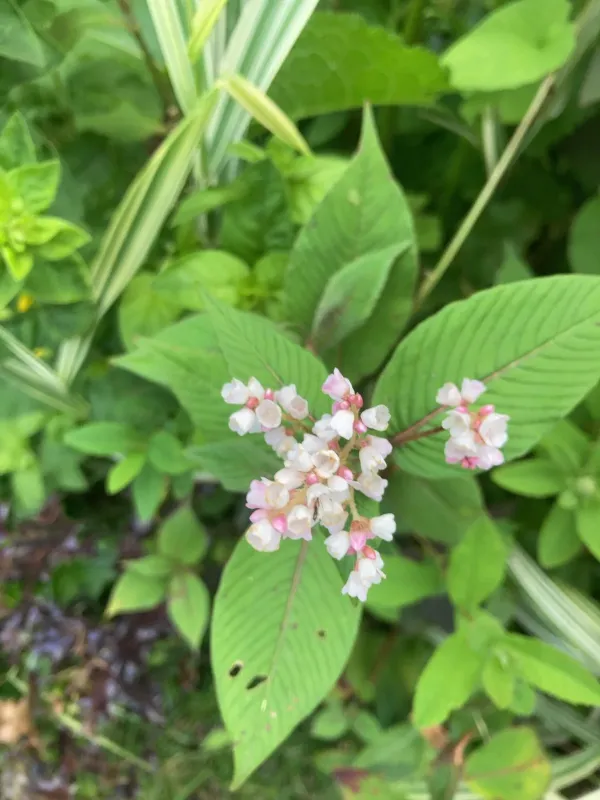
The plant is characterized by its large, ovate leaves with prominent veins and a distinctly pubescent or woolly texture on the underside.
Its inflorescences consist of small, bell-shaped white or pale pink flowers arranged in loose, terminal panicles that bloom throughout the summer.
The stems are often reddish and sturdy, reaching heights of up to one meter, supporting the spreading habit of the plant.
It maintains a robust, creeping rhizomatous root system that facilitates both nutrient storage and rapid clonal expansion across a territory.
Where it grows
This species thrives in moist, shaded environments, commonly colonizing stream banks, riparian zones, and neglected forest clearings.
In agricultural settings, it frequently infiltrates poorly drained fields, irrigation ditches, and areas adjacent to permanent vegetable crops.
It prefers high moisture availability and can easily establish itself in heavy soils where water retention supports its aggressive rhizome growth.
The plant is highly adaptable to various light conditions, moving from woodland edges into open, damp arable land with ease.
Spread is largely driven by mechanical disturbance of soil, which transports fragments of rhizomes to new, uninfested locations.
Harm it causes
Campanulate knotweed causes significant economic loss by outcompeting commercial crops for essential resources like soil nitrogen and water.
Its dense foliage creates thick mats that effectively shade out smaller seedlings, preventing successful establishment of sown agricultural species.
The complex root architecture makes it a formidable competitor that draws moisture from deep soil layers, inducing drought stress in crops.
As a dense perennial cover, it serves as an alternative host for various pests and fungal pathogens that threaten domestic crops.
The presence of this weed complicates harvest operations, as its woody stems and fibrous roots can clog machinery and delay field maintenance.
How to control
Mechanical removal is necessary for long-term control, involving the systematic extraction of the entire rhizome network from the soil profile.
Frequent mowing or cutting of the aerial parts is recommended to starve the roots of energy, though this process requires multiple seasons to achieve results.
Chemical control using systemic herbicides like glyphosate is most effective when applied during the active growth phase, preferably before flowering.
Exclusion strategies, such as using heavy-duty landscape fabrics, can suppress new growth in restricted, high-infestation areas of the field.
Integrated pest management suggests monitoring field edges and sanitation zones to prevent the initial colonizing fragments from entering the production area.
Taxonomy
- Latin name
- Koenigia campanulata
- Family
- Гречишные
- EPPO code
- POLCM