
African milk tree
Euphorbia trigona
Description
How to tell it apart
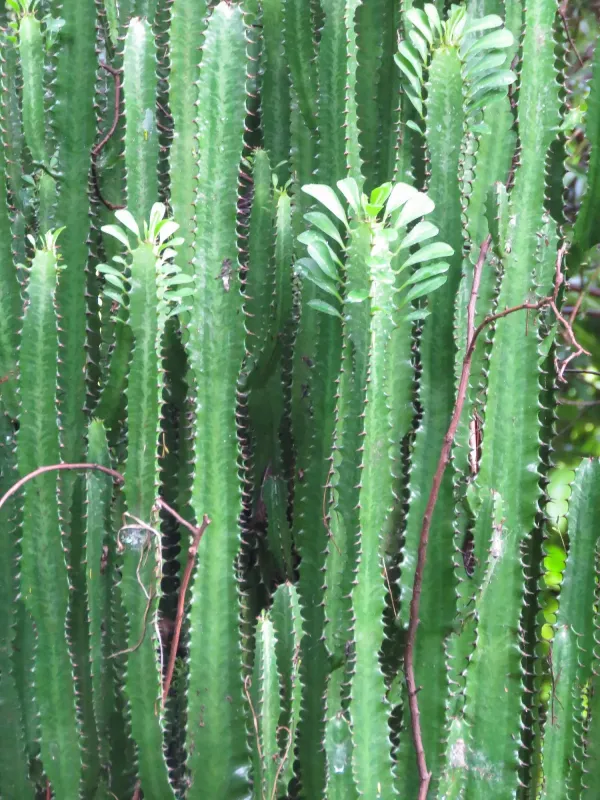
The African milk tree (Euphorbia trigona) is a perennial succulent belonging to the Euphorbiaceae family. It is characterized by a distinct triangular-shaped stem with thorn-covered edges.
The plant grows in an upright, pillar-like structure. Small, deciduous leaves may grow along the ribs of the stem, but they often fall off during periods of stress or seasonal changes.
The most important botanical feature is the thick, white latex sap that exudes from the plant when the tissue is damaged. This sap is highly toxic and causes severe irritation and blistering on human skin.
The root system is shallow but robust, allowing the plant to stabilize itself quickly in various soil conditions and survive periods of extreme water deficiency.
It reproduces effectively through vegetative propagation. Any segment of the stem that breaks off and contacts moist soil can develop roots and grow into a new, independent plant.
Where it grows
Native to tropical Africa, this species thrives in hot, arid, and sunny environments. In agricultural settings, it is often found in warmer regions with long dry seasons.
It can become a significant weed in overgrazed pastures, abandoned farmlands, and areas bordering fields where regular soil maintenance is neglected.
The plant is not particularly competitive in waterlogged or heavy clay soils, preferring well-drained, porous environments. It requires significant space to establish its root system.
Human activity is the primary vector for spreading this weed, as agricultural machinery often transports stem segments across fields during soil cultivation processes.
It colonizes disturbed areas very quickly, forming dense thickets that effectively prevent the growth of desirable forage or crop species in the immediate vicinity.
Harm it causes
The primary concern regarding this plant is its toxicity. It poses a serious threat to livestock; ingestion can lead to severe gastrointestinal damage and chemical burns to the mouth and throat.
It exhibits allelopathic properties, releasing chemical substances into the soil that inhibit the germination and development of neighboring crops.
The plant acts as a strong competitor for light and limited soil nutrients, leading to reduced yields in areas where the weed is allowed to establish a strong presence.
The presence of sharp thorns and thick, woody stems significantly hinders mechanical harvesting and field operations, potentially damaging farm equipment.
Its high resilience makes it a difficult weed to eradicate, as even small overlooked fragments can initiate a secondary infestation within a single season.
How to control
Manual removal is the most common control strategy. Workers must wear protective eyewear and gloves to avoid direct contact with the caustic sap during the extraction process.
Deep tillage is effective for clearing the weed, as it severs the root system and exposes the succulent stems to direct sunlight, which helps to dehydrate and destroy them.
Chemical control involving systemic herbicides is difficult due to the plant's succulent structure; however, concentrated applications on cut stems can sometimes improve mortality rates.
Preventive maintenance involves regular clearing of field boundaries and paths to ensure that the plant does not set the stage for further encroachment into crop zones.
- Always use protective gear when handling the plant.
- Ensure complete removal of all debris from the field to prevent re-rooting.
- Monitor field edges to prevent local spread.
Taxonomy
- Latin name
- Euphorbia trigona
- Family
- Молочай
- EPPO code
- EPHTG