
Field spurge
Euphorbia segetalis
Description
How to tell it apart
Field spurge (Euphorbia segetalis) is a weed belonging to the Euphorbiaceae family. It is typically found as an annual or biennial herb in agricultural fields and disturbed habitats.
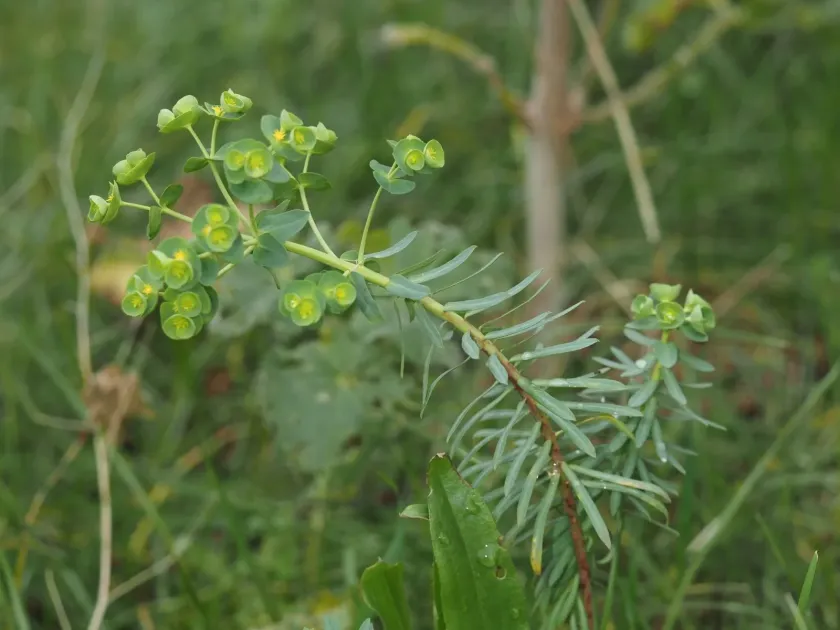
The plant grows to a height of 10 to 40 cm, featuring an upright, hairless stem that often branches out from the base. Its leaves are narrow, linear, or lance-shaped, arranged alternately along the stem.
The inflorescence consists of terminal umbels with characteristic yellow-green glands that produce nectar to attract pollinators. This structure is typical for the genus Euphorbia.
A primary identifying feature is the milky, thick white latex sap present in all parts of the plant. This sap is considered toxic and can irritate the skin upon direct contact.
The root system is a robust taproot, which allows the plant to access deep water reserves, making it resilient to drought conditions common in summer months.
Where it grows
Field spurge is primarily found in Mediterranean regions, but it has spread across various temperate and warm climatic zones, thriving in open, sunlit areas.
It prefers well-drained, sandy, or light-textured soils. It is frequently observed in cereal fields, pulse crops, fallow land, and along road verges where vegetation is sparse.
As a weed, it is highly competitive during the early stages of crop development, especially in winter cereals where it can emerge concurrently with the main crop.
The seeds of Euphorbia segetalis are capable of surviving in the soil for several years, creating a long-term seed bank that necessitates consistent management practices.
The plant colonizes fields efficiently through seed dispersal, which can be unintentionally facilitated by agricultural machinery during soil cultivation and harvesting.
Harm it causes
The primary impact of field spurge on agriculture is its intense competition with crops for water, nutrients, and sunlight, leading to significant yield reductions.
Its deep taproot allows it to deplete soil moisture more effectively than many shallow-rooted crop varieties, putting pressure on crops during drought stress periods.
If harvested along with forage, the toxic nature of the plant's latex can contaminate hay or silage, potentially causing health issues for livestock if ingested in large quantities.
High infestation levels interfere with farm operations, clogging machinery and increasing the labor and fuel costs associated with crop maintenance.
The presence of the weed increases the risk of spreading pathogens, as it can serve as a host for various diseases that affect common agricultural crops.
How to control
Effective management begins with mechanical practices such as deep moldboard plowing, which buries seeds and cuts the taproots of the plants during early growth stages.
Crop rotation is essential for breaking the life cycle of the weed, especially by alternating grain crops with dense, smothering crops that shade out spurge seedlings.
In row crops, inter-row cultivation is highly effective at eliminating the weed, as it disrupts the root system and prevents the plant from maturing and producing seeds.
Chemical control focuses on applying selective herbicides. Systemic herbicides, particularly those targeting broadleaf weeds, are most effective when applied during the active growth phase.
- Application of 2,4-D or Dicamba-based herbicides in cereal crops.
- Monitoring fields to prevent the weed from reaching the seed-bearing stage.
- Using high-quality, certified seeds to avoid introducing weeds into the field.
Taxonomy
- Latin name
- Euphorbia segetalis
- Family
- Молочайные
- EPPO code
- EPHSE