
Hairy spurge
Euphorbia hirta
Description
How to tell it apart
Hairy spurge (Euphorbia hirta) is an annual herb belonging to the Euphorbiaceae family, recognized by its densely hairy stems that can be either erect or prostrate in growth habit.
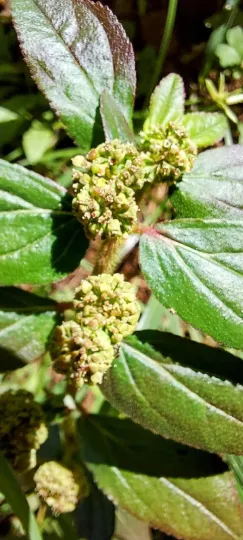
The leaves are opposite, oblong or lanceolate in shape, often featuring a serrated margin and a distinct reddish or purple blotch in the center of the leaf blade.
Its flowers are tiny, packed into compact, spherical cyathia located in leaf axils, which serve as a primary diagnostic feature for identifying this specific plant species.
When the stem or leaves are injured, the plant exudes a thick, milky white sap, a characteristic trait of many species within the genus Euphorbia that contains bioactive compounds.
The root system consists of a sturdy taproot, providing the plant with excellent anchorage and the ability to thrive in various soil types and moisture levels.
Where it grows
This weed is native to tropical and subtropical regions worldwide, flourishing in warm climates where high temperatures and moisture levels support continuous growth cycles.
In agricultural settings, it commonly invades field crops, orchards, tea plantations, and disturbed lands, often establishing itself along irrigation ditches and moist field edges.
Hairy spurge thrives in loose, fertile soils where competition from taller, more aggressive vegetation is limited, allowing it to quickly dominate open patches.
The plant is highly heat-dependent, making it a significant nuisance during the warmer months when it can complete its life cycle in a relatively short period.
It frequently colonizes row crops, legumes, and vegetable fields, especially under intensive irrigation regimes that provide the necessary conditions for its proliferation.
Harm it causes
The primary damage caused by Hairy spurge is its intense competition with crops for essential resources including water, soil nutrients, and sunlight, leading to stunted crop development.
By emerging quickly and covering the soil surface, it can crowd out young crop seedlings, significantly reducing plant population density and eventual yield per hectare.
The plant's milky sap contains toxic diterpene esters that render it unpalatable to livestock and potentially harmful if ingested, complicating the use of infested areas for grazing.
Hairy spurge acts as an alternative host for various viral and fungal pathogens, facilitating the spread of these diseases to adjacent economically important crops.
Its high seed production capacity leads to a rapid accumulation of the weed seed bank in the soil, ensuring that the infestation persists through subsequent growing seasons.
How to control
Effective agrotechnical control measures include deep plowing during land preparation, which buries seeds deep enough to prevent successful germination and emergence.
Timely mechanical inter-row cultivation is essential to destroy young weeds before they reach the flowering stage and produce new seeds for the next cycle.
Implementing strategic crop rotation with highly competitive, canopy-forming crops helps suppress the growth of the spurge by shading the soil surface.
Chemical control involves the application of systemic herbicides during the early active growth stages, ensuring the weeds are treated before maturity.
- Application of pre-emergence herbicides to suppress early growth.
- Use of post-emergence herbicides on non-crop land or via directed spraying.
- Manual removal of plants in small-scale gardens before seed set.
- Cleaning of farm machinery to prevent the spread of seeds between fields.
Taxonomy
- Latin name
- Euphorbia hirta
- Family
- Молочайные
- EPPO code
- EPHHI