
Drummond's spurge
Euphorbia drummondii
Description
How to tell it apart
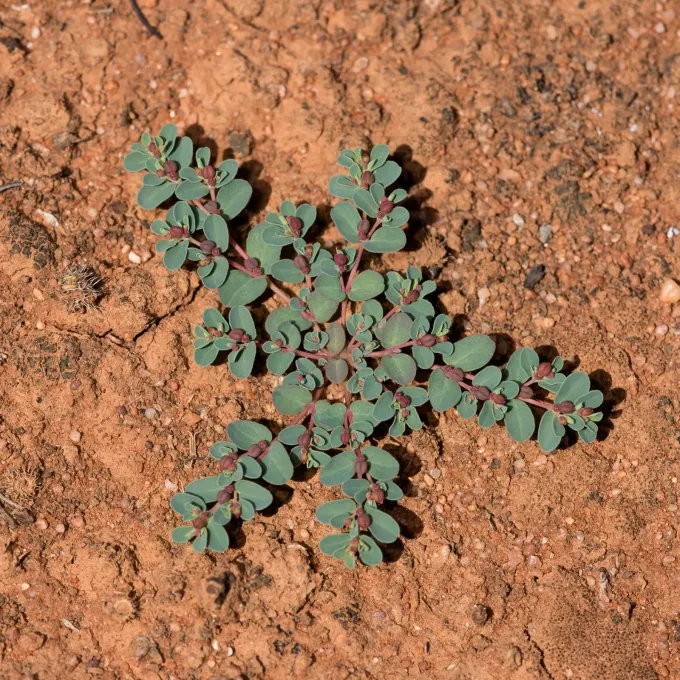
Drummond's spurge (Euphorbia drummondii) is a prostrate perennial herb belonging to the Euphorbiaceae family. It typically grows as a mat-forming plant with spreading or ascending stems.
The leaves are small, opposite, and often possess a glaucous or reddish tint. Like other members of the genus Euphorbia, it exudes a milky latex when injured, which is toxic and potentially irritating to skin and mucous membranes.
The plant features a deep, robust taproot that allows it to survive in arid environments, often making it difficult to pull out manually.
Its flowers are arranged in small, inconspicuous structures known as cyathia, which are characteristic of the genus and lack showy petals, making the weed easily overlooked in early growth stages.
The fruit is a small, three-lobed capsule that bursts upon maturity, dispersing seeds in the immediate vicinity and contributing to the rapid expansion of weed patches.
Where it grows
This weed favors open, sun-exposed areas such as pastures, roadsides, disturbed soils, and fallow fields. It thrives in well-drained, sandy, or rocky soils.
In agricultural settings, it frequently infests cereal, legume, and row crops. It is particularly competitive in arid climates where rainfall is sparse and crop competition is low.
Drummond's spurge is highly adaptable to poor-quality soils and can colonize eroded areas where other plants fail to thrive.
Dissemination often occurs through the movement of contaminated agricultural equipment or the use of crop seeds that have not been properly cleaned of weed contaminants.
In neglected pastures, it can form dense colonies, displacing native grasses and significantly reducing the forage quality for livestock.
Harm it causes
The primary agricultural impact of Drummond's spurge is its allelopathic potential, as it releases root exudates that inhibit the growth of surrounding crops.
It is toxic to livestock. Ingestion of the plant, whether fresh or dried in hay, can lead to severe poisoning, affecting the health and productivity of grazing animals.
The weed competes aggressively for moisture and nutrients. Because of its deep taproot, it persists even during severe droughts, outcompeting shallow-rooted crop varieties.
By forming dense, low-growing mats, it shades out emerging crop seedlings, leading to reduced stand density and lower overall yields.
During harvest, the presence of this weed creates operational hurdles, as the milky sap and dense foliage can clog machinery and increase the moisture content of the harvested grain.
How to control
Successful management strategies focus on integrated approaches, including crop rotation with competitive species that shade out the weed population effectively.
Mechanical control through deep tillage is essential for disrupting the root system, which helps to exhaust the plant's food reserves and prevents spreading by root fragments.
- Frequent mowing or inter-row cultivation to exhaust root energy reserves.
- Sourcing high-quality, certified seeds to prevent introduction into clean fields.
- Targeted control of small patches along field borders to prevent further spread.
Chemical control typically involves the application of systemic herbicides. These are most effective when applied during the active growth phase when the plant is translocating sugars to its roots.
The waxy cuticle on the leaves can reduce herbicide absorption; therefore, the use of appropriate surfactants or adjuvants is often required to ensure maximum efficacy of the chemical treatment.
Taxonomy
- Latin name
- Euphorbia drummondii
- Family
- Молочайные
- EPPO code
- EPHDR