
Caperonia palustris
Caperonia palustris
Description
How to tell it apart
Caperonia palustris is an annual herbaceous weed belonging to the Euphorbiaceae family. It is a persistent plant adapted to aquatic and semi-aquatic habitats.
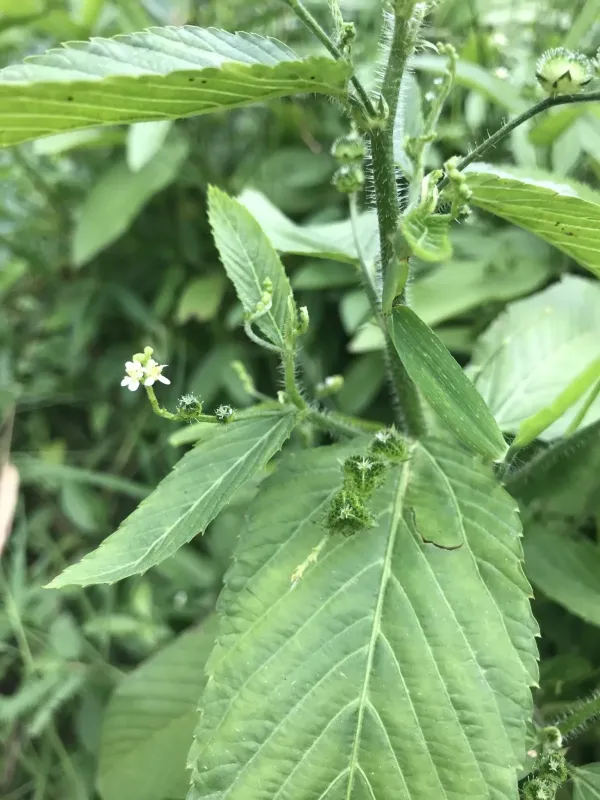
The plant features upright, pubescent stems that can grow up to one meter in height. Its leaves are typically lanceolate with serrated margins, making it distinguishable from other rice paddy weeds.
It produces small, inconspicuous flowers arranged in axillary racemes. These flowers are usually white or greenish, often overlooked by field scouts until the infestation is significant.
The root system is well-adapted to anaerobic soil conditions found in flooded environments, allowing the plant to thrive even when submerged for extended periods.
Seed production is prolific, and the seeds possess buoyancy, allowing them to spread rapidly throughout flooded fields via irrigation water.
Where it grows
This weed is commonly found in tropical and subtropical regions. It prefers wet environments such as rice paddies, marshes, and the margins of drainage canals.
Caperonia palustris is highly specialized for life in rice cropping systems. It can germinate and grow effectively alongside rice crops as soon as the fields are flooded.
It is capable of colonizing various soil types, provided that moisture levels are sufficient for its initial germination and subsequent development phases.
The weed often thrives in areas where rice density is low, exploiting the available space and light to outcompete the crop.
Irrigation systems act as the primary vector for the dissemination of seeds across different sections of a farm or between neighboring fields.
Harm it causes
The primary damage caused by Caperonia palustris is intense competition for nutrients, water, and sunlight, which significantly stunts the growth of the rice crop.
Heavy infestations lead to reduced rice tillering and overall yield loss. The presence of the weed disrupts the uniform development of the paddy field.
Harvesting efficiency is hampered by the dense vegetation of the weed, which can clog machinery and contaminate the harvested grain with weed seeds.
Furthermore, the presence of this weed in irrigation channels can impede water flow, complicating the management of water levels across the cultivation area.
- Nutrient depletion in rice soils.
- Reduced yield due to crop competition.
- Increased costs for post-harvest grain cleaning.
How to control
Effective management begins with thorough land preparation, including timely plowing and harrowing to reduce the soil seed bank before flooding.
Water management is critical; however, since the plant is tolerant of flooding, water control alone is rarely sufficient to eliminate an established population.
Chemical control remains the most reliable strategy. Selective herbicides should be applied at the early vegetative stages of the weed to ensure maximum efficacy.
Farmers are advised to rotate herbicide modes of action to prevent the development of resistant weed populations, which can occur with frequent herbicide use.
Maintenance of irrigation infrastructure is essential to prevent the influx of new seeds into the paddies, thereby reducing the need for intensive chemical intervention.
Taxonomy
- Latin name
- Caperonia palustris
- Family
- Молочай
- EPPO code
- CNPPA