
Virginia pepperweed
Lepidium virginicum
Description
How to tell it apart
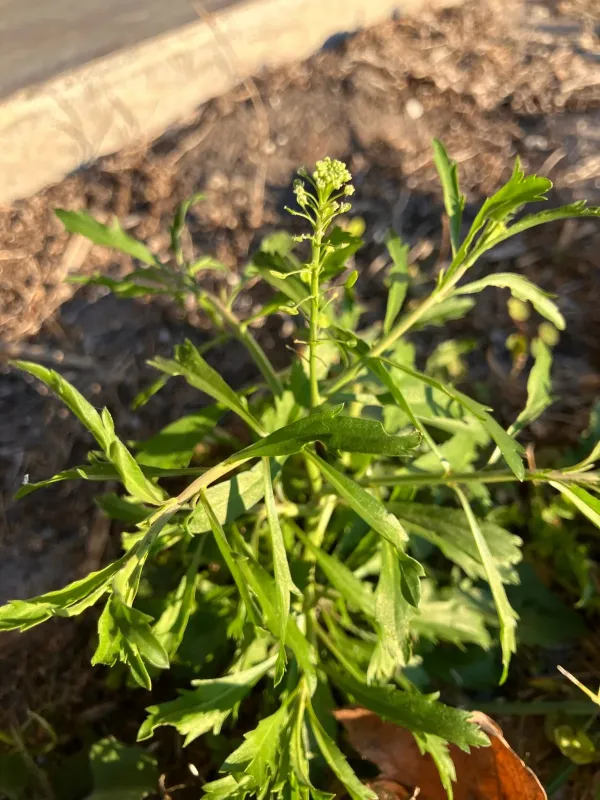
Virginia pepperweed (Lepidium virginicum) is an annual or biennial herbaceous weed belonging to the Brassicaceae family, typically growing to a height of 20–50 cm.
The stems are erect and branched. The leaves display a distinct pattern: basal leaves are pinnately lobed, while upper leaves are linear or entire.
The flowers are small, white, and arranged in elongated racemes. They are easily distinguished by their small white petals that are shorter than the sepals.
Fruits are characteristic flat, rounded silicles with a notched apex. Each fruit contains small, light brown seeds that disperse easily by wind or water.
The plant has a strong biological resilience and a prolific seed production capability, which allows it to establish rapidly in various soil conditions.
Where it grows
This weed is commonly found in fields, roadsides, disturbed areas, and gardens. It shows a preference for sunny, open habitats with well-drained soils.
It frequently infests winter grain crops, perennial grasses, and vegetable patches, posing a significant challenge to farmers in open-field agriculture.
The plant is known for its ability to adapt to a wide range of moisture levels, including surviving in semi-arid conditions that may limit other weeds.
It often acts as an invasive species in managed landscapes, colonizing gaps in crop stands where competition is relatively low.
On pastures, it can dominate areas where soil compaction or overgrazing has occurred, reducing the available biomass for livestock.
Harm it causes
The primary harm caused by Virginia pepperweed is its direct competition for nutrients, light, and water, which significantly impacts the yield of crops.
Dense infestations can impede the harvesting process, leading to increased mechanical harvesting difficulty and potential product loss in the field.
The plant serves as a host for various diseases and pests that affect economically important crops in the mustard family, such as canola or cabbage.
Its high seed production ensures a persistent seed bank in the soil, necessitating multi-year management strategies to achieve eradication or control.
Seed contamination by this weed reduces the quality of harvested grain, often requiring additional cleaning processes and lowering the market value of the crop.
How to control
Effective management requires an integrated approach, utilizing cultural practices, mechanical interventions, and chemical herbicides to keep populations low.
Cultural methods include rigorous crop rotation and fallow tillage, which disrupt the weed’s lifecycle before it can set seed during the growing season.
In cereal crops, post-emergence application of herbicides targeting broadleaf weeds, such as 2,4-D or sulfonylureas, is highly effective for population reduction.
Small-scale mechanical control, such as manual pulling or hoeing before the plants flower, is recommended to prevent the replenishment of the soil seed bank.
Strict sanitation protocols for farm equipment must be followed to prevent the movement of seeds from infested zones to non-infested fields during planting or harvesting.
Taxonomy
- Latin name
- Lepidium virginicum
- Family
- Крестоцветные
- EPPO code
- LEPVI