
Flixweed
Descurainia sophia
Description
How to tell it apart
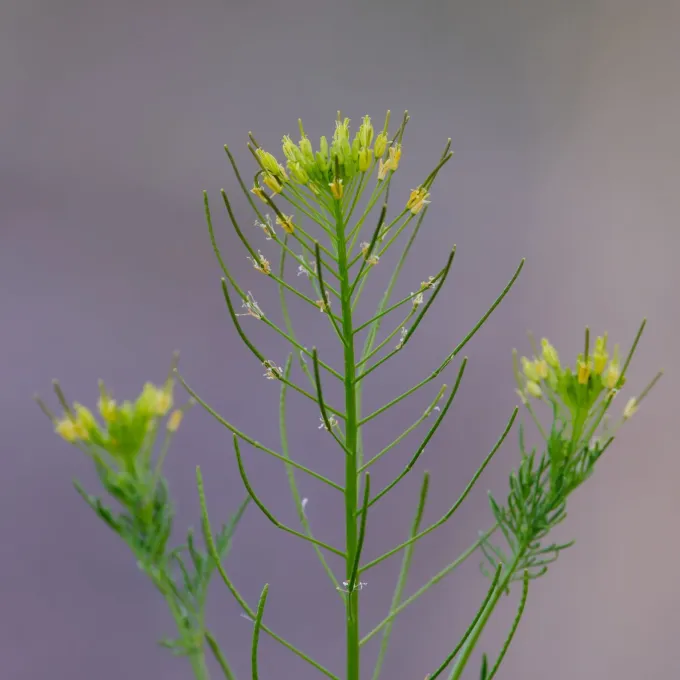
Flixweed (Descurainia sophia) is an annual or biennial herbaceous plant belonging to the Brassicaceae family. It is easily identified by its fine, feathery, greyish-green foliage covered in star-shaped hairs.
The stems are erect and highly branched, typically reaching a height of 20 to 80 cm. The plant has a sprawling growth habit that allows it to occupy significant surface area.
Leaves are alternate and finely dissected into small, linear segments, which gives the plant a characteristic "lacy" appearance throughout its growth cycle.
Flowers are small and yellowish, arranged in terminal racemes. They have four petals that are shorter than the sepals, a diagnostic feature that helps distinguish it from other mustard species.
The fruit consists of slender, slightly curved pods known as siliques, which contain numerous tiny seeds that can persist in the soil for several years.
Where it grows
Flixweed is a ubiquitous weed found in disturbed areas, roadsides, waste grounds, and agricultural fields globally. It thrives in nitrogen-rich soils.
In farming, it is particularly problematic in winter grain crops, such as winter wheat and rye, due to its ability to germinate in the autumn and grow early in the spring.
It is frequently observed in spring cereal fields, set-aside land, and areas with minimum tillage, where it can quickly establish dense colonies.
The plant is highly adaptable to various soil types and moisture regimes, allowing it to invade fields even under less-than-ideal growing conditions for crops.
Seed dispersal occurs primarily through wind and agricultural machinery, making it difficult to contain without integrated management strategies.
Harm it causes
Flixweed acts as a significant competitor for nutrients, water, and sunlight. In dense infestations, it can significantly reduce the biomass and grain yield of crops.
Its early-season growth gives it a competitive edge over winter crops, shading them out and forcing them to compete for limited resources during crucial development stages.
The plant serves as an alternate host for several insect pests and pathogens that affect cruciferous crops, thereby increasing the disease pressure in the field.
The presence of Flixweed during harvest can contaminate crop yields, lowering the quality of grain and leading to increased costs for cleaning and drying.
Its rapid seed production means that a single plant can significantly increase the seed bank in the soil, leading to long-term management challenges for producers.
How to control
Agrotechnical management includes maintaining a robust crop rotation and implementing thorough seedbed preparation to bury seeds to a depth that prevents germination.
Cultivation practices such as harrowing or shallow tillage during the early growth stages of the weed are effective in reducing its population density before it flowers.
Chemical control should be implemented using systemic post-emergence herbicides, ideally applied while the weeds are in the seedling or rosette stage for maximum efficacy.
Tank mixing different herbicide modes of action is recommended to broaden the spectrum of control and to prevent the development of resistant weed populations.
Consistent monitoring and spot treatment of weed patches can prevent the spread of seeds across the field, ensuring long-term field hygiene and sustainable yields.
Taxonomy
- Latin name
- Descurainia sophia
- Family
- Крестоцветные
- EPPO code
- DESSO