

Granstar Pro 75
«Дюпон Інтернешнл Оперейшнз Сарл», Швейцарія
Herbicides
0
0
·
61
4 offers
3.47 €per pack
Buy
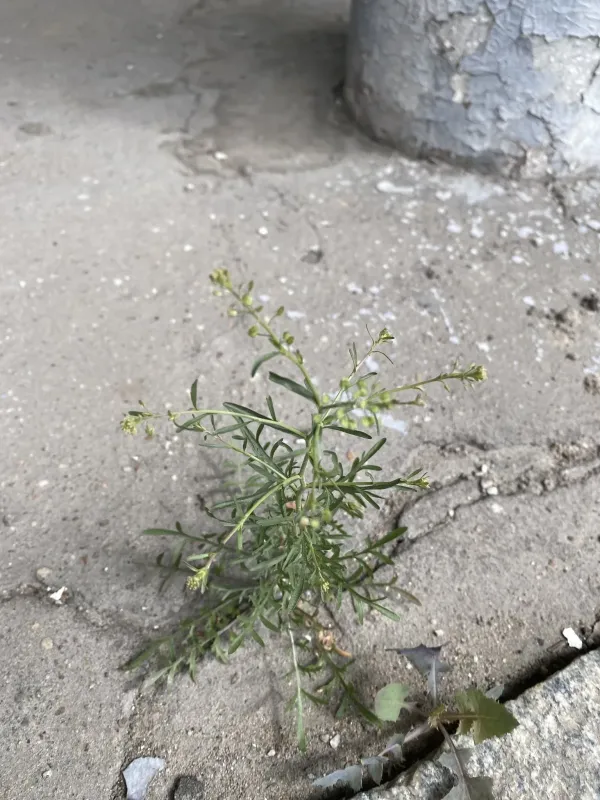
Lepidium ruderale, commonly known as pepperweed, is an annual herbaceous weed belonging to the Brassicaceae family, often found in disturbed environments.
The plant features a well-developed taproot system and an erect, branched stem reaching heights of 15 to 40 centimeters. When crushed, the leaves emit a distinct, unpleasant odor.
The leaf morphology varies: lower leaves are pinnately lobed, while upper leaves are entire and linear. These shapes are diagnostic characteristics for identifying the plant in the field.
Flowers are very small, greenish-white, and lack petals, being arranged in dense racemes. This specific floral structure helps distinguish it from other related cruciferous weeds.
The fruit is a small, flattened silicle containing seeds. These seeds remain viable in the soil for several years, ensuring that the weed persists even after control attempts.
Pepperweed is a typical ruderal species, frequently colonizing roadsides, wasteland, gravel areas, and areas surrounding farm buildings and infrastructure.
In agricultural settings, it commonly infests grain crops, row crops, and pastures, especially where soil has been disturbed or the crop canopy is open.
The plant is highly resilient and thrives in various soil types, including compacted, dry, and even slightly saline soils where other plants struggle to grow.
Dispersal is primarily mediated by seeds, which can be moved by wind, water, or agricultural equipment. This makes containment on farms a challenging task.
It tends to establish itself along the edges of fields and headlands, from where it spreads inward into the main production areas if not properly managed.
Pepperweed acts as a strong competitor for essential soil nutrients and sunlight, which can significantly stunt the growth of young crops if left uncontrolled.
By shading the crop canopy during the early stages of development, the weed reduces photosynthetic efficiency, leading to lower biomass and yield potential.
The presence of this weed creates a microclimate with higher humidity near the soil surface, which can promote the development of various fungal pathogens.
It serves as an alternative host for several insect pests that attack Brassica crops, increasing the pressure on integrated pest management systems.
Contamination of grain harvests with pepperweed seeds requires additional cleaning processes, increasing production costs and reducing the market grade of the final product.
Effective cultural control includes maintaining a competitive crop stand through proper fertilization and seeding density to suppress the development of weeds.
Deep tillage remains a standard practice to bury seeds at depths that prevent successful germination, effectively reducing the weed seed bank in the soil.
Mechanical cultivation between rows is highly recommended for row crops to eliminate emerging seedlings before they reach the flowering stage.
Chemical control involving selective herbicides is common, targeting the rosette stage of the plant when it is most susceptible to active ingredients.
