
Lens pepperweed
Lepidium repens
Description
How to tell it apart
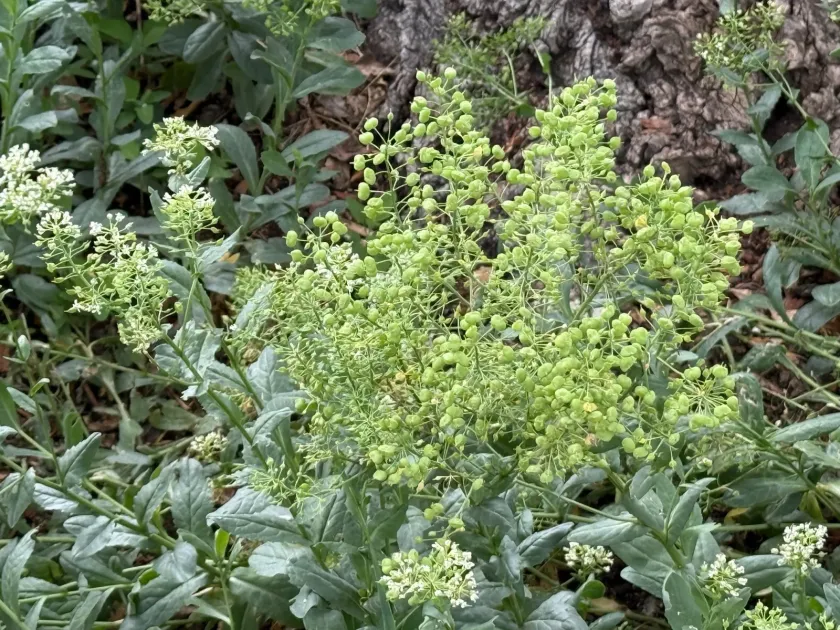
Lens pepperweed (Lepidium repens) is a perennial root-sprouting weed belonging to the Brassicaceae family, known for its invasive growth habit.
The plant features a robust root system that penetrates deep into the soil profile, allowing it to regenerate effectively even after mechanical damage.
Stems are typically branched, leaves show characteristic features of the mustard family, and small flowers form dense racemes.
It is capable of vegetative propagation from small root fragments, which makes it a persistent and difficult weed to eradicate completely.
The seeds of this species possess high viability, remaining dormant in the soil bank for extended periods until suitable germination conditions occur.
Where it grows
This weed is commonly found in arable fields, pastures, along roadsides, and in saline soils where other plants struggle to grow.
It poses a significant threat to cereal and broad-leaved crop production by rapidly occupying cultivated areas through its aggressive root network.
Lens pepperweed thrives in open, sunny environments and is frequently identified in fallow lands, where it quickly establishes dominant colonies.
In irrigated cropping systems, the weed exhibits particularly vigorous growth, often outcompeting the target crop for space and resources.
Its presence is also problematic in perennial forage fields, where it reduces the overall quality and nutritional value of the harvested hay.
Harm it causes
The primary concern is the extreme competition for soil moisture; the weed's deep roots extract water that is crucial for crop development during drought periods.
It acts as a strong competitor for soil nutrients, causing significant reductions in crop yields and overall biomass production in treated areas.
Dense patches of Lens pepperweed create microclimates that are conducive to the spread of various plant pathogens and insect pests.
Harvesting efficiency is significantly reduced in infested fields, as the weed mass increases moisture content in the crop and clogs machinery.
Allelopathic properties of the weed can suppress the germination and initial growth of neighboring crop plants, leading to uneven crop stands.
How to control
Mechanical control involves deep primary tillage and frequent cultivation designed to sever roots and deplete the plant's stored carbohydrate reserves.
Integrating fallow periods within the crop rotation is a highly effective method to systematically exhaust the weed's regenerative capacity.
Chemical control strategies should prioritize systemic herbicides that translocate through the plant into the roots to ensure complete kill.
Applying herbicides during the active growth phase is critical for effective translocation and control of the perennial root system.
- Crop rotation strategies.
- Systemic herbicide applications.
- Mechanical weeding and tillage.
- Clean seed sourcing and field sanitation.
Taxonomy
- Latin name
- Lepidium repens
- Family
- Крестоцветные
- EPPO code
- LEPRE