
Perfoliate pepperweed
Lepidium perfoliatum
Description
How to tell it apart
Perfoliate pepperweed (Lepidium perfoliatum) is a member of the Brassicaceae family. It is an annual herbaceous plant that typically functions as a winter or spring weed in various agricultural systems.
The most distinctive morphological feature is its stem leaves: they are heart-shaped and appear to be "pierced" by the stem, which is the source of its specific epithet. Lower leaves are usually pinnately dissected, contrasting with the entire upper leaves.
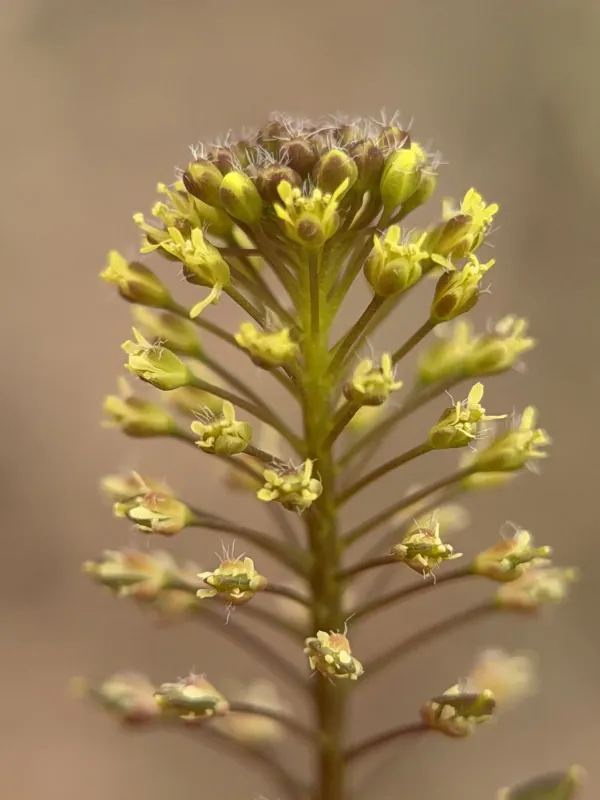
The plant features an erect stem, often branched at the top, typically ranging from 20 to 50 centimeters in height. The flowers are small, clustered in racemes, and possess the four characteristic yellow petals typical of cruciferous plants.
The fruit of the pepperweed is a small, rounded or broadly ovate silicle that becomes flattened at maturity. The plant is highly fecund, producing large quantities of seeds that ensure its persistence in agroecosystems.
It has a taproot system that, while relatively weakly branched, is highly efficient at extracting moisture and nutrients from the topsoil, allowing the weed to compete successfully with crops during early growth stages.
Where it grows
This species is widely distributed across Central and Eastern Europe, the Caucasus, and Central and Western Asia. In recent decades, it has expanded its range into North America, Australia, and parts of the Russian Far East.
Perfoliate pepperweed prefers open, well-lit environments. It is commonly found in fallow land, along roadsides, in pastures, and on disturbed sites near human settlements and agricultural operations.
In field conditions, the weed is particularly problematic in winter cereal crops, as its biological cycle often coincides with the crop's development. It is also frequently found in row crops and fallow fields.
The plant is not highly demanding regarding soil quality, though it favors light, sandy, or loamy soils where competition for space is low. It exhibits tolerance to drought and early spring temperature drops.
The damage caused by this weed in crops is primarily due to its early spring growth, allowing it to deplete soil moisture and nutrients before the crop reaches its peak growth period.
Harm it causes
The primary economic impact of Lepidium perfoliatum is the reduction in crop yields through direct competition for essential resources. It tends to deplete soil nutrients more rapidly than many cultivated cereals.
The weed serves as a host for various pests and pathogens common to the Brassicaceae family. It can harbor infections that may subsequently spread to crops like rapeseed, mustard, or other cruciferous vegetables.
The presence of pepperweed seeds in grain shipments can decrease the market value of the harvest. Cleaning seeds of these impurities requires additional investments in grading and sorting processes.
In cases of heavy infestation, the weed can thin out crop stands significantly, creating patches where the target crop fails to thrive due to intense weed pressure.
High seed production rates enable the weed to rapidly colonize new areas if crop rotation practices are neglected. The soil seed bank can remain viable for several years, making long-term control necessary.
How to control
The primary agronomic control method is strict adherence to crop rotation to prevent the accumulation of seeds in the soil. Diversifying the crop sequence disrupts the plant's life cycle.
Effective primary tillage, such as deep plowing with moldboard turnover, is crucial for burying seeds to depths where germination becomes impossible or severely inhibited.
Mechanical inter-row cultivation in row crops effectively suppresses pepperweed seedlings. It is essential to perform these operations while the weed is in the rosette stage to ensure success.
- Thorough cleaning of seed grain stocks.
- Removal of weeds from non-cropped areas (field edges, paths).
- Post-harvest stubble cultivation to encourage seed germination and subsequent destruction.
Chemical control involves the use of selective herbicides, such as sulfonylureas or products based on 2,4-D and dicamba, within cereal crops. Pesticide application is most effective during the early vegetative stages.
Taxonomy
- Latin name
- Lepidium perfoliatum
- Family
- Крестоцветные
- EPPO code
- LEPPE