
Shining pepperweed
Lepidium nitidum
Description
How to tell it apart
Shining pepperweed (Lepidium nitidum) belongs to the Brassicaceae family. It is an herbaceous plant generally categorized as an annual or winter-annual weed.
The plant is characterized by branched stems and small, slightly glossy leaves, which is the source of its specific epithet 'nitidum' or 'shining'.
The flowers are small and arranged in racemes, typical of the mustard family, allowing for relatively easy identification in the field.
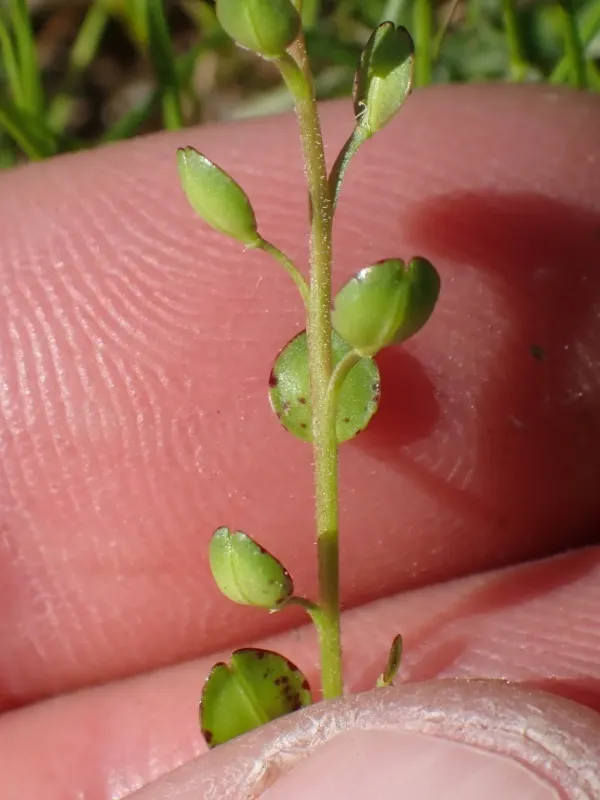
The fruit is a small pod or silicle, which, upon maturation, facilitates the effective dispersal of seeds across the surrounding area.
It possesses a taproot system, which allows the plant to compete effectively for deep soil moisture, giving it an advantage over many shallow-rooted crops.
Where it grows
This weed species is primarily native to North America, where it thrives in agricultural fields, orchards, along roadsides, and on disturbed land.
In agroecosystems, shining pepperweed demonstrates aggressive behavior in cereal fields, legumes, and vegetable crops, especially in temperate climate zones.
It prefers sunny, well-drained environments but has a high level of adaptability to various soil types, including those that are depleted or slightly saline.
Its ecological flexibility enables it to quickly colonize arable lands if monitoring and preventative cleaning of fields are neglected.
It often grows in mixed weed communities, forming dense mats that can significantly suppress the early growth stages of nearby crops.
Harm it causes
The primary harmful impact of shining pepperweed is its intense competition with crops for space, sunlight, essential nutrients, and soil water.
Infestation by this weed leads to reduced crop yields, as the weed depletes vital resources during the critical phases of crop development.
The presence of this weed complicates mechanical harvesting and can increase the moisture content of grain, leading to higher post-harvest processing costs.
Contamination of harvested grain with weed seeds lowers the commercial value and quality of the crop, necessitating expensive cleaning procedures at grain terminals.
Furthermore, the plant acts as a host for various pests and pathogens that affect cruciferous crops, complicating overall plant health management strategies.
How to control
Effective control of shining pepperweed requires an integrated weed management (IWM) strategy, combining agronomic practices with chemical control.
Agronomic methods include deep autumn tillage to bury seeds and prevent germination, as well as maintaining a strict crop rotation schedule.
It is essential to conduct mechanical removal of the weeds during the early rosette stage to prevent flowering and the production of viable seeds.
Application of systemic herbicides during the early growth stages of the weed provides significant reduction in populations within cereal and row crops.
Preventative measures, such as the use of certified, weed-free seeds and maintaining field hygiene, are crucial to prevent the spread of this species.
Taxonomy
- Latin name
- Lepidium nitidum
- Family
- Крестоцветные
- EPPO code
- LEPNI