
Sand pepperweed
Lepidium lasiocarpum
Description
How to tell it apart
Sand pepperweed (Lepidium lasiocarpum) is a herbaceous plant species belonging to the Brassicaceae family.
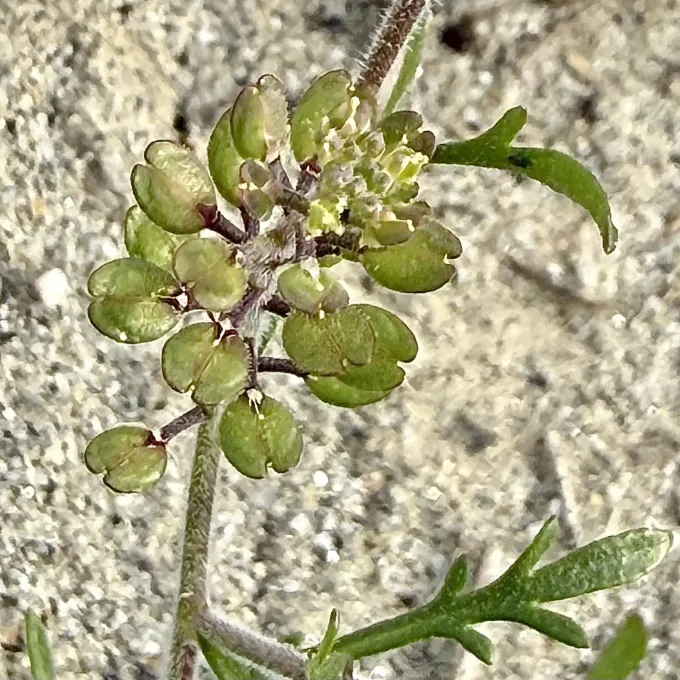
It is distinguished by its fruit, which is covered in short hairs, a feature that distinguishes it from other common pepperweeds.
The plant typically grows as an erect, branched annual herb with serrated or pinnately lobed leaves.
Its small flowers are clustered in racemes, common in the mustard family, developing into small, hairy seed pods.
As a prolific early-spring annual, it can quickly establish itself in disturbed environments through its high seed production capacity.
Where it grows
The species is primarily native to North America and is classified as a significant weed in agricultural and ruderal habitats.
It prefers dry to moist sandy or gravelly soils, commonly appearing in fields, roadsides, and abandoned lands.
In farming, it frequently infests cereal crops and vegetable fields, especially in areas where soil moisture is limited.
The plant is well-adapted to disturbed soils, often appearing as an early colonizer in fallow or cultivated fields.
Its ability to thrive in poor soils makes it a persistent weed in regions with varying agricultural practices.
Harm it causes
Sand pepperweed competes directly with crops for vital resources such as sunlight, water, and soil nutrients during the critical germination phase.
By crowding out young seedlings, it leads to reduced crop density and overall yield losses in infested areas.
It can act as an alternate host for various pests and diseases that affect other cruciferous crops, potentially increasing field pressure.
The presence of its seeds in harvested grain can contaminate the product, leading to decreased market value and quality standards.
Severe infestations increase the difficulty of mechanized harvesting and necessitate additional post-harvest cleaning operations.
How to control
Integrated weed management for this species focuses on preventing seed bank accumulation through consistent soil cultivation.
Early-season mechanical control, such as inter-row cultivation, is highly effective at reducing sand pepperweed populations in row crops.
Crop rotation practices can significantly disrupt the life cycle of this annual weed by altering the environmental conditions of the field.
Chemical control involving selective herbicides provides a viable strategy for managing infestations in post-emergence stages.
- Timely tillage to eliminate seedlings before they set seed.
- Utilization of weed-free certified seeds for planting.
- Application of selective broad-spectrum herbicides consistent with crop labels.
Taxonomy
- Latin name
- Lepidium lasiocarpum
- Family
- Крестоцветные
- EPPO code
- LEPLC