
Field cress
Lepidium campestre
Description
How to tell it apart
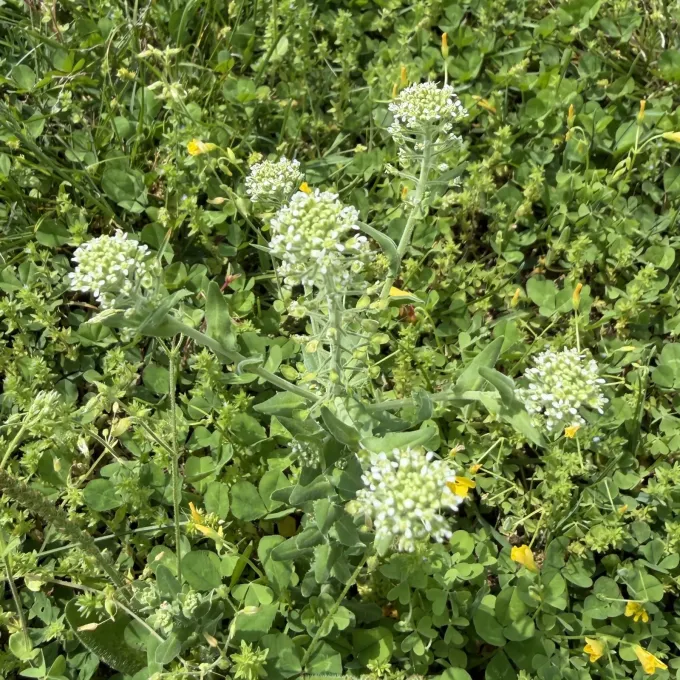
Field cress (Lepidium campestre) is an annual or biennial herbaceous plant belonging to the Brassicaceae family, often reaching a height of 20 to 60 cm.
The stems are usually erect and branched in the upper part. Basal leaves form a rosette, while stem leaves are sessile, sagittate, and clasp the stem.
Small white flowers are arranged in dense terminal racemes that elongate significantly as the plant matures during its spring to early summer flowering period.
The fruit is a small, rounded, flattened silicle with a notched tip and winged margins, containing small, rough, brown seeds.
The plant reproduces entirely through seed production, with a single individual capable of yielding thousands of seeds that can persist in the soil for several years.
Where it grows
Native to Southern Europe and the Caucasus, field cress has become naturalized in many European countries, North America, and South Africa.
It typically thrives in agricultural fields, particularly in winter and spring cereals, as well as on roadsides, waste ground, and disturbed pastures.
The plant prefers well-drained, fertile soils but shows high adaptability to various environments, often appearing in fields where soil structure is compromised.
Its ability to survive the winter as a rosette allows it to compete aggressively with autumn-sown crops from the very beginning of the growing season.
It often establishes itself on field margins and unmanaged borders, slowly encroaching into the main crop area if perimeter control is neglected.
Harm it causes
Field cress is a strong competitor for essential nutrients, water, and sunlight, significantly inhibiting the growth and development of primary crops.
In cereal crops, it causes substantial yield reductions, especially when infestation levels are high and competition occurs during the crop's tillering phase.
As a member of the Brassicaceae family, it can act as a reservoir host for various pests and fungal pathogens, potentially increasing disease pressure on crops.
Contamination of harvested grain with field cress seeds lowers the market quality of the produce and complicates post-harvest cleaning processes.
The presence of this weed necessitates intensive herbicide use, which increases operational costs and impacts the overall economic efficiency of the farm.
How to control
Integrated weed management, starting with a well-planned crop rotation, is essential to disrupt the life cycle and reduce the soil seed bank.
Mechanical control through deep plowing and timely cultivation of stubble fields can effectively suppress the growth of overwintering rosettes.
Sanitation of field edges and surrounding non-cropped areas is critical to prevent the spread of seeds into the cultivated sections of the farm.
Chemical control should be implemented using selective systemic herbicides during the early rosette stage to maximize efficacy and minimize crop damage.
- Use high-quality, certified seeds free from weed contaminants.
- Regular scouting of fields to identify early infestation stages.
- Application of sulfonylurea or growth-regulator herbicides as prescribed by regional guidelines.
Taxonomy
- Latin name
- Lepidium campestre
- Family
- Крестоцветные
- EPPO code
- LEPCA